Ch. 6 - Inverse Circular Functions and Trigonometric Equations
Lial - Trigonometry 12th Edition
Lial12th EditionTrigonometryISBN: 9780136552161당신이 사용하는 게 아니라요?교과서 변경
7장, 문제 97

Write each trigonometric expression as an algebraic expression in u, for u > 0.
cos (arcsin u)

검증된 단계별 안내
1
Recognize that the expression is \( \cos(\arcsin u) \). Here, \( \arcsin u \) represents an angle \( \theta \) such that \( \sin \theta = u \).
Set \( \theta = \arcsin u \), so by definition, \( \sin \theta = u \). Since \( u > 0 \), \( \theta \) is in the range \( \left[-\frac{\pi}{2}, \frac{\pi}{2}\right] \) where cosine is non-negative.
Use the Pythagorean identity for sine and cosine: \( \sin^2 \theta + \cos^2 \theta = 1 \). Substitute \( \sin \theta = u \) to get \( u^2 + \cos^2 \theta = 1 \).
Solve for \( \cos \theta \): \( \cos \theta = \sqrt{1 - u^2} \). Since \( \theta \) is in the first or fourth quadrant (due to the range of arcsin), cosine is positive, so take the positive root.
Therefore, \( \cos(\arcsin u) = \sqrt{1 - u^2} \), which is the algebraic expression in terms of \( u \).

비슷한 문제에 대한 검증된 영상 답변:

이 영상 해법은 위 문제에 도움이 된다고 튜터들이 추천한 것입니다.
도움이 되었나요?

주요 개념

질문에 올바르게 답하기 위해 반드시 이해해야 하는 핵심 개념들은 다음과 같습니다.

Inverse Trigonometric Functions

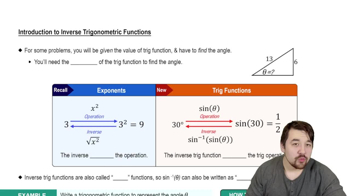
Inverse trigonometric functions, like arcsin, return the angle whose trigonometric ratio equals a given value. For example, arcsin(u) gives an angle θ such that sin(θ) = u. Understanding this allows us to rewrite expressions involving inverse functions in terms of angles.
추천 영상:
4:28
Introduction to Inverse Trig Functions

Pythagorean Identity

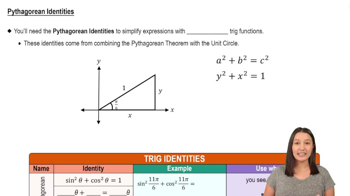
The Pythagorean identity states that for any angle θ, sin²(θ) + cos²(θ) = 1. This relationship helps express one trigonometric function in terms of another, such as finding cos(θ) when sin(θ) is known, which is essential for rewriting cos(arcsin u) algebraically.
추천 영상:
6:25
Pythagorean Identities

Domain and Range Considerations

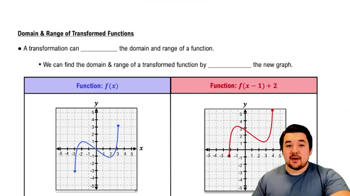
When dealing with inverse trigonometric functions, it's important to consider the domain and range to determine the correct sign of the resulting expression. Since u > 0 and arcsin(u) lies in [-π/2, π/2], cos(arcsin u) will be non-negative, guiding the choice of the positive root in the algebraic expression.
추천 영상:
4:22
Domain and Range of Function Transformations