Ch. 7 - Applications of Trigonometry and Vectors
Lial - Trigonometry 12th Edition
Lial12th EditionTrigonometryISBN: 9780136552161당신이 사용하는 게 아니라요?교과서 변경
8장, 문제 29a

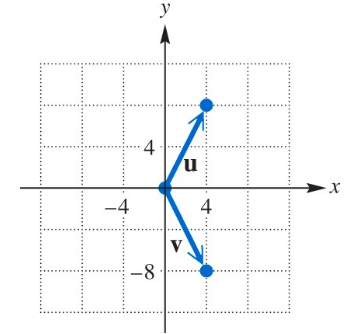
Use the figure to find each vector: u + v. Use vector notation as in Example 4.


검증된 단계별 안내
1
Identify the components of vectors \( \mathbf{u} \) and \( \mathbf{v} \) from the figure. Typically, each vector can be broken down into its horizontal (x) and vertical (y) components. For example, \( \mathbf{u} = (u_x, u_y) \) and \( \mathbf{v} = (v_x, v_y) \).
Write down the components of \( \mathbf{u} \) and \( \mathbf{v} \) explicitly. If the figure provides magnitudes and directions (angles), use trigonometric functions to find components: \( u_x = |\mathbf{u}| \cos \theta_u \), \( u_y = |\mathbf{u}| \sin \theta_u \), and similarly for \( \mathbf{v} \).
Add the corresponding components of the vectors to find the resultant vector \( \mathbf{u} + \mathbf{v} \):
\[ \mathbf{u} + \mathbf{v} = (u_x + v_x, \; u_y + v_y) \]
Express the resultant vector \( \mathbf{u} + \mathbf{v} \) in vector notation, typically as \( \langle u_x + v_x, \; u_y + v_y \rangle \).
If needed, find the magnitude and direction of the resultant vector using:
\[ |\mathbf{u} + \mathbf{v}| = \sqrt{(u_x + v_x)^2 + (u_y + v_y)^2} \]
and
\[ \theta = \tan^{-1} \left( \frac{u_y + v_y}{u_x + v_x} \right) \]

비슷한 문제에 대한 검증된 영상 답변:

이 영상 해법은 위 문제에 도움이 된다고 튜터들이 추천한 것입니다.
도움이 되었나요?

주요 개념

질문에 올바르게 답하기 위해 반드시 이해해야 하는 핵심 개념들은 다음과 같습니다.

Vector Addition

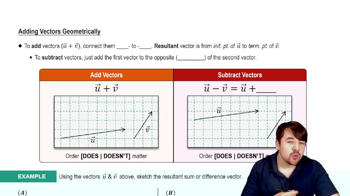
Vector addition involves combining two vectors to form a resultant vector by adding their corresponding components or by placing them head-to-tail graphically. The sum vector u + v represents the combined effect of vectors u and v.
추천 영상:
05:29
Adding Vectors Geometrically

Vector Notation

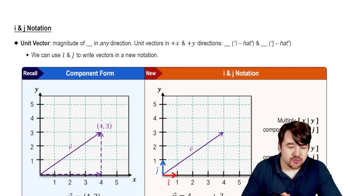
Vector notation expresses vectors typically as ordered pairs or triplets (e.g., <x, y>) representing their components along coordinate axes. This notation simplifies calculations and clearly shows the direction and magnitude of vectors.
추천 영상:
06:01
i & j Notation

Graphical Representation of Vectors

Vectors can be represented graphically as arrows with direction and length proportional to magnitude. Understanding how to interpret and draw vectors on a coordinate plane is essential for visualizing vector addition and verifying results.
추천 영상:
04:19
Finding Direction of a Vector Example 1