The bearing of a lighthouse from a ship was found to be N 37° E. After the ship sailed 2.5 mi due south, the new bearing was N 25° E. Find the distance between the ship and the lighthouse at each location.
Ch. 7 - Applications of Trigonometry and Vectors
Lial12th EditionTrigonometryISBN: 9780136552161, 9780135440780, 9780136881117, 9780135440827, 9780135924891당신이 사용하는 게 아니라요?교과서 변경
8장, 문제 36
A force of 28.7 lb makes an angle of 42° 10′ with a second force. The resultant of the two forces makes an angle of 32° 40′ with the first force. Find the magnitudes of the second force and of the resultant.
<IMAGE>
검증된 단계별 안내1
Convert all given angles from degrees and minutes to decimal degrees for easier calculation. For example, 42° 10′ becomes \(42 + \frac{10}{60}\) degrees, and similarly for 32° 40′.
Let the magnitude of the second force be \(F_2\) and the magnitude of the resultant force be \(R\). The first force \(F_1\) is given as 28.7 lb.
Use the Law of Cosines to relate the magnitudes of the forces and the angle between them. The angle between the two forces is \$42° 10′$, so write the equation:
\(R^2 = F_1^2 + F_2^2 + 2 F_1 F_2 \cos(42° 10′)\)
Use the Law of Sines to relate the angles and sides in the triangle formed by the two forces and their resultant. The resultant makes an angle of \$32° 40′$ with the first force, so write:
\(\frac{F_2}{\sin(32° 40′)} = \frac{R}{\sin(42° 10′ + 32° 40′)}\)
Solve the system of two equations from steps 3 and 4 simultaneously to find the unknown magnitudes \(F_2\) and \(R\).

비슷한 문제에 대한 검증된 영상 답변:
이 영상 해법은 위 문제에 도움이 된다고 튜터들이 추천한 것입니다.
주요 개념
질문에 올바르게 답하기 위해 반드시 이해해야 하는 핵심 개념들은 다음과 같습니다.
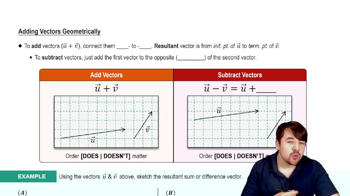
Vector Addition of Forces
When two forces act at an angle, their combined effect is found by vector addition. The resultant force is the vector sum of the individual forces, considering both magnitude and direction. Understanding how to add vectors graphically or analytically is essential to solve for unknown forces.
추천 영상:
Adding Vectors Geometrically
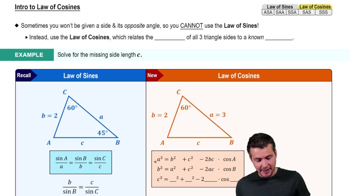
Law of Cosines in Vector Problems
The Law of Cosines relates the magnitudes of two vectors and the angle between them to the magnitude of their resultant. It is used to find unknown sides or angles in non-right triangles formed by force vectors, enabling calculation of the second force or resultant magnitude.
추천 영상:
가이드 코스
Intro to Law of Cosines
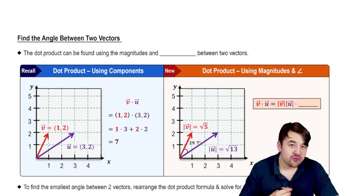
Angle Relationships Between Forces and Resultant
The angles between forces and their resultant are crucial for setting up equations. Knowing the angle the resultant makes with one force helps determine the direction and magnitude of the other force using trigonometric relationships and vector components.
추천 영상:
Find the Angle Between Vectors
관련 실천
교과서 질문
1450
views
교과서 질문
Solve each triangle. See Examples 2 and 3.
a = 3.0 ft, b = 5.0 ft, c = 6.0 ft
676
views
교과서 질문
Given u = 〈-2, 5〉 and v = 〈4, 3〉, find each of the following.
-5v
705
views
교과서 질문
A force of 25 lb is required to hold an 80-lb crate on a hill. What angle does the hill make with the horizontal?
858
views
교과서 질문
Radio direction finders are placed at points A and B, which are 3.46 mi apart on an east-west line, with A west of B. From A the bearing of a certain radio transmitter is 47.7°, and from B the bearing is 302.5°. Find the distance of the transmitter from A.
913
views
교과서 질문
A force of 176 lb makes an angle of 78° 50′ with a second force. The resultant of the two forces makes an angle of 41° 10′ with the first force. Find the magnitudes of the second force and of the resultant.
<IMAGE>
924
views