Ch. 7 - Applications of Trigonometry and Vectors
Lial - Trigonometry 12th Edition
Lial12th EditionTrigonometryISBN: 9780136552161, 9780135440780, 9780136881117, 9780135440827, 9780135924891당신이 사용하는 게 아니라요?교과서 변경
8장, 문제 54

A plane flies 650 mph on a bearing of 175.3°. A 25-mph wind, from a direction of 266.6°, blows against the plane. Find the resulting bearing of the plane.

검증된 단계별 안내
1
Identify the velocity vectors of the plane and the wind. The plane's velocity vector has a magnitude of 650 mph and a direction (bearing) of 175.3°. The wind's velocity vector has a magnitude of 25 mph and a direction of 266.6° (wind direction means the wind is coming from this bearing, so the wind's velocity vector points toward 266.6° + 180° = 86.6°).
Convert both velocity vectors from polar form (magnitude and bearing) to Cartesian coordinates (x and y components) using the formulas: \(x = v \times \sin(\theta)\) and \(y = v \times \cos(\theta)\), where \(\theta\) is the bearing angle in degrees.
Add the corresponding components of the plane's velocity vector and the wind's velocity vector to find the resultant velocity vector components: \(V_x = V_{plane,x} + V_{wind,x}\) and \(V_y = V_{plane,y} + V_{wind,y}\).
Calculate the magnitude of the resultant velocity vector using the Pythagorean theorem: \(V = \sqrt{V_x^2 + V_y^2}\) (this step is optional if only the bearing is required).
Find the resulting bearing of the plane by calculating the angle of the resultant vector relative to the north direction using the inverse tangent function: \(\theta = \arctan\left(\frac{V_x}{V_y}\right)\). Adjust the angle to the correct quadrant and convert it to a bearing between 0° and 360°.

주요 개념

질문에 올바르게 답하기 위해 반드시 이해해야 하는 핵심 개념들은 다음과 같습니다.

Vector Addition in Navigation

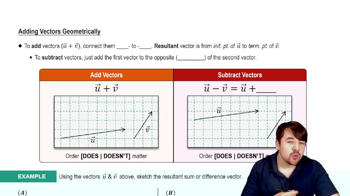
In navigation problems, the actual path of an object is found by adding its velocity vector to the velocity vector of external factors like wind. This involves breaking velocities into components, adding them, and then recombining to find the resultant vector representing the true direction and speed.
추천 영상:
가이드 코스
05:29
Adding Vectors Geometrically

Bearing and Angle Measurement

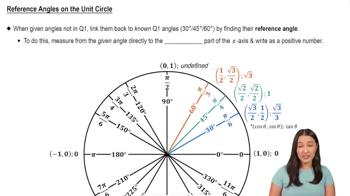
Bearing is a way to express direction using degrees measured clockwise from the north (0° or 360°). Understanding how to interpret and convert bearings into standard angles for calculations is essential for solving problems involving directions and navigation.
추천 영상:
가이드 코스
5:31
Reference Angles on the Unit Circle

Trigonometric Components of Vectors

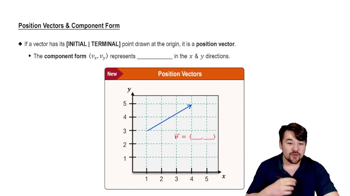
Vectors can be decomposed into horizontal (x) and vertical (y) components using sine and cosine functions based on their angles. This decomposition allows for precise calculation of resultant vectors by summing components along each axis before finding magnitude and direction.
추천 영상:
가이드 코스
03:55
Position Vectors & Component Form