
교과서 질문
In each figure, a line segment of length L is to be drawn from the given point to the positive x-axis in order to form a triangle. For what value(s) of L can we draw the following?
c. no triangle
<IMAGE>
614
views

 검증된 단계별 안내
 05:29
05:29
 5:08
5:08 05:13
05:13In each figure, a line segment of length L is to be drawn from the given point to the positive x-axis in order to form a triangle. For what value(s) of L can we draw the following?
c. no triangle
<IMAGE>
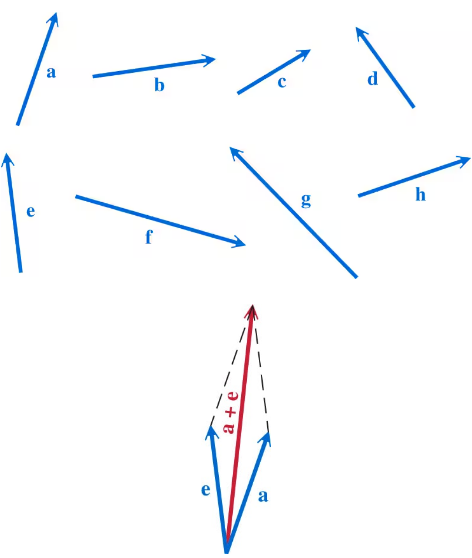
CONCEPT PREVIEW Refer to vectors a through h below. Make a copy or a sketch of each vector, and then draw a sketch to represent each of the following. For example, find a + e by placing a and e so that their initial points coincide. Then use the parallelogram rule to find the resultant, as shown in the figure on the right.
2c
Determine the number of triangles ABC possible with the given parts.
a = 50, b = 26, A = 95°
Use the law of sines to find the indicated part of each triangle ABC.
Find b if a = 165 m, A = 100.2°, B = 25.0°
CONCEPT PREVIEW Assume a triangle ABC has standard labeling.
a. Determine whether SAA, ASA, SSA, SAS, or SSS is given.
b. Determine whether the law of sines or the law of cosines should be used to begin solving the triangle.
a, B, and C
Find the unknown angles in triangle ABC for each triangle that exists.
A = 142.13°, b = 5.432 ft, a = 7.297 ft