Ch. 7 - Applications of Trigonometry and Vectors
Lial - Trigonometry 12th Edition
Lial12th EditionTrigonometryISBN: 9780136552161당신이 사용하는 게 아니라요?교과서 변경
8장, 문제 43a

Given vectors u and v, find: 2u. 
u = 〈-1, 2〉, v = 〈3, 0〉

검증된 단계별 안내
1
Identify the vector \( \mathbf{u} = \langle -1, 2 \rangle \) and the scalar multiplier, which is 2 in this case.
Recall that multiplying a vector by a scalar means multiplying each component of the vector by that scalar.
Apply the scalar multiplication to vector \( \mathbf{u} \): multiply the first component by 2 and the second component by 2.
Write the resulting vector as \( 2\mathbf{u} = \langle 2 \times (-1), 2 \times 2 \rangle \).
Simplify the components to express the final vector in the form \( \langle a, b \rangle \), where \( a \) and \( b \) are the products from the previous step.

비슷한 문제에 대한 검증된 영상 답변:

이 영상 해법은 위 문제에 도움이 된다고 튜터들이 추천한 것입니다.
도움이 되었나요?

주요 개념

질문에 올바르게 답하기 위해 반드시 이해해야 하는 핵심 개념들은 다음과 같습니다.

Vector Scalar Multiplication

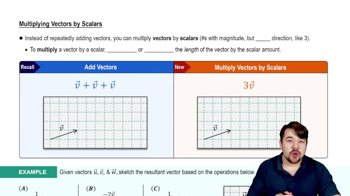
Scalar multiplication involves multiplying each component of a vector by a scalar (a real number). For example, multiplying vector u = 〈x, y〉 by 2 results in 2u = 〈2x, 2y〉. This operation scales the vector's magnitude without changing its direction.
추천 영상:
05:05
Multiplying Vectors By Scalars

Vector Notation and Components

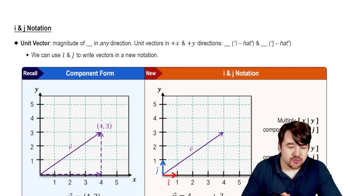
Vectors in two dimensions are represented as ordered pairs 〈x, y〉, where x and y are components along the horizontal and vertical axes. Understanding this notation is essential for performing operations like addition, subtraction, and scalar multiplication.
추천 영상:
06:01
i & j Notation

Basic Vector Operations

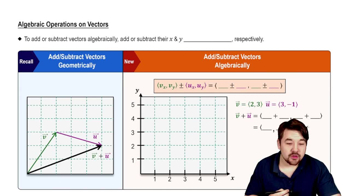
Basic vector operations include addition, subtraction, and scalar multiplication. These operations follow component-wise rules, allowing manipulation of vectors algebraically. Mastery of these operations is fundamental for solving vector-related problems.
추천 영상:
04:12
Algebraic Operations on Vectors