Ch. 7 - Applications of Trigonometry and Vectors
Lial - Trigonometry 12th Edition
Lial12th EditionTrigonometryISBN: 9780136552161, 9780135440780, 9780136881117, 9780135440827, 9780135924891당신이 사용하는 게 아니라요?교과서 변경
8장, 문제 13

Refer to vectors a through h below. Make a copy or a sketch of each vector, and then draw a sketch to represent each of the following. For example, find a + e by placing a and e so that their initial points coincide. Then use the parallelogram rule to find the resultant, as shown in the figure on the right.


<IMAGE>


a + (b + c)

검증된 단계별 안내
1
Begin by sketching each of the vectors \( \mathbf{a} \), \( \mathbf{b} \), and \( \mathbf{c} \) separately, paying attention to their directions and magnitudes as given or implied in the problem.
Next, focus on the expression inside the parentheses: \( \mathbf{b} + \mathbf{c} \). To add these two vectors, place the initial point of \( \mathbf{c} \) at the terminal point of \( \mathbf{b} \).
Use the parallelogram rule or the tip-to-tail method to find the resultant vector \( \mathbf{b} + \mathbf{c} \). This resultant vector starts at the initial point of \( \mathbf{b} \) and ends at the terminal point of \( \mathbf{c} \) after placement.
Now, to find \( \mathbf{a} + (\mathbf{b} + \mathbf{c}) \), place the initial point of the resultant vector \( \mathbf{b} + \mathbf{c} \) at the terminal point of \( \mathbf{a} \).
Finally, draw the resultant vector starting from the initial point of \( \mathbf{a} \) to the terminal point of \( \mathbf{b} + \mathbf{c} \) after placement. This vector represents \( \mathbf{a} + (\mathbf{b} + \mathbf{c}) \).

비슷한 문제에 대한 검증된 영상 답변:

이 영상 해법은 위 문제에 도움이 된다고 튜터들이 추천한 것입니다.

주요 개념

질문에 올바르게 답하기 위해 반드시 이해해야 하는 핵심 개념들은 다음과 같습니다.

Vector Addition

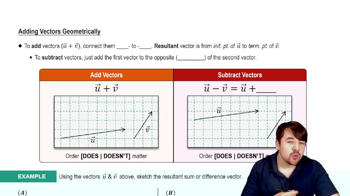
Vector addition involves combining two or more vectors to find a resultant vector. This is done by placing the initial point of one vector at the terminal point of another and then drawing the resultant from the start of the first to the end of the last vector. It follows the commutative and associative properties.
추천 영상:
05:29
Adding Vectors Geometrically

Parallelogram Rule

The parallelogram rule is a geometric method to add two vectors. By placing both vectors so their initial points coincide, a parallelogram is formed using the vectors as adjacent sides. The diagonal of this parallelogram from the common initial point represents the resultant vector.
추천 영상:
5:08
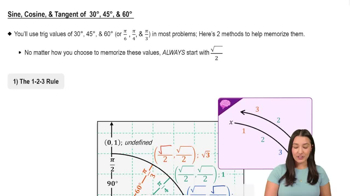
Sine, Cosine, & Tangent of 30°, 45°, & 60°

Associative Property of Vector Addition

The associative property states that when adding three or more vectors, the grouping does not affect the resultant vector. For example, a + (b + c) equals (a + b) + c. This property allows flexibility in how vectors are combined and simplifies calculations.
추천 영상:
05:29
Adding Vectors Geometrically