Ch. 7 - Applications of Trigonometry and Vectors
Lial - Trigonometry 12th Edition
Lial12th EditionTrigonometryISBN: 9780136552161당신이 사용하는 게 아니라요?교과서 변경
8장, 문제 51

Solve each problem. See Examples 5 and 6.


Bearing and Ground Speed of a Plane An airline route from San Francisco to Honolulu is on a bearing of 233.0°. A jet flying at 450 mph on that bearing encounters a wind blowing at 39.0 mph from a direction of 114.0°. Find the resulting bearing and ground speed of the plane.

검증된 단계별 안내
1
Identify the vectors involved: the plane's velocity vector and the wind's velocity vector. The plane's velocity is 450 mph on a bearing of 233.0°, and the wind's velocity is 39.0 mph from a bearing of 114.0°. Remember that "from" a direction means the wind is coming from 114.0°, so its direction of travel is 114.0° + 180° = 294.0°.
Convert both velocity vectors into their component form using trigonometry. For a vector with magnitude \(v\) and bearing \(\theta\), the components are: \(x = v \times \sin\left(\frac{\pi}{180} \times \theta\right)\) \(y = v \times \cos\left(\frac{\pi}{180} \times \theta\right)\) Calculate the components for the plane and the wind separately.
Add the corresponding components of the plane and wind vectors to find the resultant ground velocity vector: \(x_{result} = x_{plane} + x_{wind}\) \(y_{result} = y_{plane} + y_{wind}\)
Calculate the magnitude of the resultant ground speed using the Pythagorean theorem: \(\text{Ground Speed} = \sqrt{x_{result}^2 + y_{result}^2}\)
Determine the resulting bearing of the plane by finding the angle of the resultant vector relative to north. Use the inverse tangent function: \(\theta = \arctan\left(\frac{x_{result}}{y_{result}}\right)\) Adjust the angle to the correct quadrant and convert it back to a bearing between 0° and 360°.

비슷한 문제에 대한 검증된 영상 답변:

이 영상 해법은 위 문제에 도움이 된다고 튜터들이 추천한 것입니다.
영상 길이:
10m
도움이 되었나요?

주요 개념

질문에 올바르게 답하기 위해 반드시 이해해야 하는 핵심 개념들은 다음과 같습니다.

Bearing and Direction in Navigation

Bearing is the angle measured clockwise from the north direction to the line of travel, expressed in degrees from 0° to 360°. Understanding bearings is essential for navigation problems, as it helps represent directions precisely, such as the plane's route at 233° and wind direction at 114°.
추천 영상:
05:13
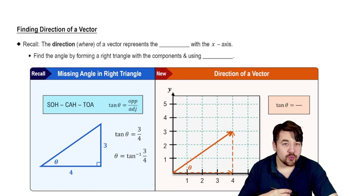
Finding Direction of a Vector

Vector Addition of Velocities

The plane's velocity relative to the ground is the vector sum of its airspeed vector and the wind velocity vector. Adding these vectors requires breaking them into components, summing the components, and then recombining to find the resultant velocity's magnitude and direction.
추천 영상:
03:48
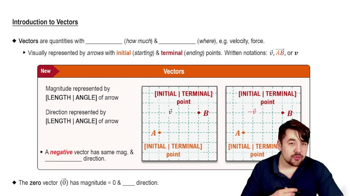
Introduction to Vectors

Trigonometric Resolution of Vectors

Resolving vectors into components uses sine and cosine functions based on their bearings. By converting speeds and directions into x (east-west) and y (north-south) components, trigonometry allows calculation of the resultant vector's ground speed and bearing accurately.
추천 영상:
03:48
Introduction to Vectors