Ch. 7 - Applications of Trigonometry and Vectors
Lial - Trigonometry 12th Edition
Lial12th EditionTrigonometryISBN: 9780136552161, 9780135440780, 9780136881117, 9780135440827, 9780135924891당신이 사용하는 게 아니라요?교과서 변경
8장, 문제 38

Standing on one bank of a river flowing north, Mark notices a tree on the opposite bank at a bearing of 115.45°. Lisa is on the same bank as Mark, but 428.3 m away. She notices that the bearing of the tree is 45.47°. The two banks are parallel. What is the distance across the river?

검증된 단계별 안내
1
Draw a diagram to visualize the problem: mark the positions of Mark and Lisa on the same bank, the river flowing north, and the tree on the opposite bank. Label the bearings from Mark and Lisa to the tree as 115.45° and 45.47°, respectively.
Understand that bearings are measured clockwise from the north direction. Convert these bearings into angles relative to the river bank (which runs north-south) to help form triangles for calculation.
Use the given distance between Mark and Lisa (428.3 m) as one side of a triangle formed by their positions and the tree. The bearings give you the directions from each observer to the tree, allowing you to find the angles inside this triangle.
Apply the Law of Sines to the triangle formed by Mark, Lisa, and the tree. The Law of Sines states: \(\frac{a}{\sin A} = \frac{b}{\sin B} = \frac{c}{\sin C}\), where \(a\), \(b\), and \(c\) are sides opposite angles \(A\), \(B\), and \(C\) respectively. Use this to find the distance from Mark (or Lisa) directly across the river to the tree.
Since the river banks are parallel and the tree is on the opposite bank, the distance across the river corresponds to the perpendicular distance from Mark (or Lisa) to the tree along the east-west direction. Use trigonometric relationships (such as sine or cosine of the relevant angle) to calculate this perpendicular distance.

비슷한 문제에 대한 검증된 영상 답변:

이 영상 해법은 위 문제에 도움이 된다고 튜터들이 추천한 것입니다.

주요 개념

질문에 올바르게 답하기 위해 반드시 이해해야 하는 핵심 개념들은 다음과 같습니다.

Bearings and Directional Angles

Bearings are angles measured clockwise from the north direction to the line of sight. Understanding how to interpret and use bearings is essential for locating points relative to each other on a plane, especially in navigation and surveying problems like this river crossing scenario.
추천 영상:
05:13
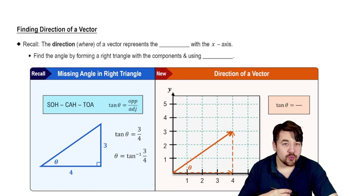
Finding Direction of a Vector

Trigonometric Applications in Triangles

Using trigonometric functions such as sine, cosine, and tangent allows calculation of unknown sides or angles in triangles formed by the observers and the tree. This problem involves applying these functions to solve for distances based on given angles and side lengths.
추천 영상:
6:04
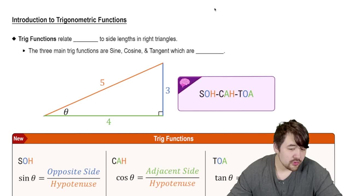
Introduction to Trigonometric Functions

Properties of Parallel Lines and Transversals

Since the two river banks are parallel, the angles formed by lines of sight and the banks relate through alternate interior or corresponding angles. Recognizing these relationships helps in setting up the correct geometric model to find the distance across the river.
추천 영상:
2:20
Imaginary Roots with the Square Root Property