Ch. R - Algebra Review
Lial - Trigonometry 12th Edition
Lial12th EditionTrigonometryISBN: 9780136552161당신이 사용하는 게 아니라요?교과서 변경
1장, 문제 17

Find each square root. See Example 1. -√256

검증된 단계별 안내
1
Recognize that the expression -\(\sqrt{256}\) means the negative of the square root of 256.
Recall that the square root of a number x, written as \(\sqrt{x}\), is a value that when multiplied by itself gives x.
Calculate \(\sqrt{256}\) by finding the number which, when squared, equals 256.
Since 16 \(\times\) 16 = 256, we have \(\sqrt{256}\) = 16.
Apply the negative sign in front of the square root to get the final expression: -\(\sqrt{256}\) = -16.

비슷한 문제에 대한 검증된 영상 답변:

이 영상 해법은 위 문제에 도움이 된다고 튜터들이 추천한 것입니다.
영상 길이:
1m
도움이 되었나요?

주요 개념

질문에 올바르게 답하기 위해 반드시 이해해야 하는 핵심 개념들은 다음과 같습니다.

Square Roots

The square root of a number is a value that, when multiplied by itself, gives the original number. For example, the square root of 256 is 16 because 16 × 16 = 256. Square roots can be positive or negative, but the principal square root is usually taken as the positive value.
추천 영상:
2:20
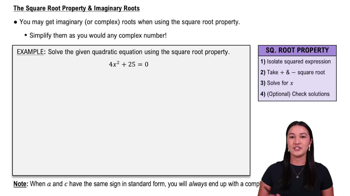
Imaginary Roots with the Square Root Property

Negative Square Roots

When a negative sign precedes a square root, such as -√256, it means the negative of the principal square root. This is different from the square root of a negative number, which involves imaginary numbers. Here, -√256 equals -16, the negative of the positive root.
추천 영상:
2:20
Imaginary Roots with the Square Root Property

Simplifying Square Roots

Simplifying square roots involves finding the exact value or expressing the root in simplest radical form. For perfect squares like 256, the square root is an integer. Recognizing perfect squares helps quickly simplify roots without a calculator.
추천 영상:
2:20
Imaginary Roots with the Square Root Property