Ch. R - Algebra Review
Lial - Trigonometry 12th Edition
Lial12th EditionTrigonometryISBN: 9780136552161당신이 사용하는 게 아니라요?교과서 변경
1장, 문제 13

Find the domain of each rational expression. See Example 1. (3x + 7) / (4x + 2) (x - 1)

검증된 단계별 안내
1
Identify the rational expression given: \(\frac{3x + 7}{(4x + 2)(x - 1)}\).
Recall that the domain of a rational expression excludes values of \(x\) that make the denominator equal to zero, because division by zero is undefined.
Set each factor in the denominator equal to zero to find the excluded values: solve \(4x + 2 = 0\) and \(x - 1 = 0\) separately.
Solve \(4x + 2 = 0\) by isolating \(x\): \(4x = -2\) then \(x = -\frac{1}{2}\); solve \(x - 1 = 0\) to get \(x = 1\).
Conclude that the domain is all real numbers except \(x = -\frac{1}{2}\) and \(x = 1\), since these values make the denominator zero.

비슷한 문제에 대한 검증된 영상 답변:

이 영상 해법은 위 문제에 도움이 된다고 튜터들이 추천한 것입니다.
영상 길이:
4m
도움이 되었나요?

주요 개념

질문에 올바르게 답하기 위해 반드시 이해해야 하는 핵심 개념들은 다음과 같습니다.

Domain of a Rational Expression

The domain of a rational expression includes all real numbers except those that make the denominator zero. Since division by zero is undefined, identifying values that cause the denominator to be zero is essential to determine the domain.
추천 영상:
2:58
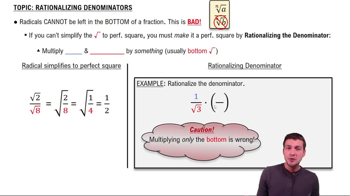
Rationalizing Denominators

Factoring and Setting Denominator Equal to Zero

To find values excluded from the domain, factor the denominator if possible and set each factor equal to zero. Solving these equations reveals the values that make the denominator zero, which must be excluded from the domain.
추천 영상:
3:42
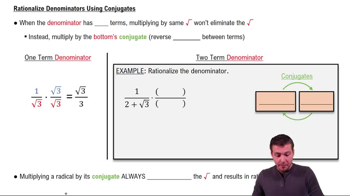
Rationalizing Denominators Using Conjugates

Simplifying Rational Expressions

Simplifying the rational expression by canceling common factors can help in understanding the expression better, but it does not change the domain. The original restrictions from the denominator remain, regardless of simplification.
추천 영상:
2:58
Rationalizing Denominators