
Ch. R - Algebra Review
Lial - Trigonometry 12th Edition
Lial12th EditionTrigonometryISBN: 9780136552161당신이 사용하는 게 아니라요?교과서 변경
1장, 문제 147

For Individual or Group Work (Exercises 147 – 150)In calculus, it is sometimes desirable to rationalize a numerator. To do this, we multiply the numerator and the denominator by the conjugate of the numerator. For example, (6 - √2)/4 = (6 - √2)/4 × (6 + √2)/(6 + √2) = (36 - 2)/(4(6 + √2)) = 34/(4(6 + √2)) = 17/(2(6 + √2)) = 17/(6 + √2). Rationalize each numerator. (6 - √3)/8

검증된 단계별 안내
1
Identify the expression to rationalize: \(\frac{6 - \sqrt{3}}{8}\). The numerator is \(6 - \sqrt{3}\), which contains a square root that we want to eliminate by rationalizing.
Find the conjugate of the numerator. The conjugate of \(6 - \sqrt{3}\) is \(6 + \sqrt{3}\). This is because conjugates have the same terms but opposite signs between them.
Multiply both the numerator and the denominator by the conjugate of the numerator to keep the expression equivalent. This gives: \(\frac{6 - \sqrt{3}}{8} \times \frac{6 + \sqrt{3}}{6 + \sqrt{3}}\).
Use the difference of squares formula to simplify the numerator: \((a - b)(a + b) = a^2 - b^2\). Here, \(a = 6\) and \(b = \sqrt{3}\), so the numerator becomes \(6^2 - (\sqrt{3})^2\).
Simplify the numerator and write the new expression as \(\frac{36 - 3}{8(6 + \sqrt{3})}\). This is the rationalized form with the numerator free of square roots.

비슷한 문제에 대한 검증된 영상 답변:

이 영상 해법은 위 문제에 도움이 된다고 튜터들이 추천한 것입니다.
영상 길이:
4m
도움이 되었나요?

주요 개념

질문에 올바르게 답하기 위해 반드시 이해해야 하는 핵심 개념들은 다음과 같습니다.

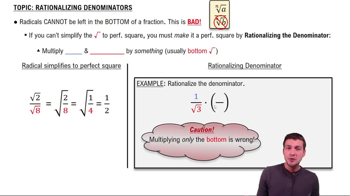
Rationalizing the Numerator

Rationalizing the numerator involves eliminating any irrational numbers (like square roots) from the numerator of a fraction. This is done by multiplying both numerator and denominator by the conjugate of the numerator, which helps simplify expressions and makes further calculations easier.
추천 영상:
2:58
Rationalizing Denominators

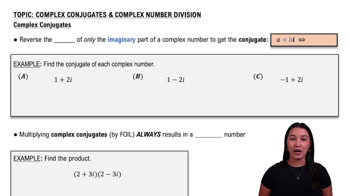
Conjugates in Algebra

The conjugate of a binomial expression a + √b is a - √b, and vice versa. Multiplying conjugates results in a difference of squares, which removes the square root terms. This property is essential for rationalizing expressions containing radicals.
추천 영상:
5:33
Complex Conjugates

Difference of Squares Formula

The difference of squares formula states that (x + y)(x - y) = x² - y². When applied to conjugates involving square roots, it eliminates the radical by converting it into a rational number, simplifying the expression significantly.
추천 영상:
2:25
Verifying Identities with Sum and Difference Formulas