Ch. R - Algebra Review
Lial - Trigonometry 12th Edition
Lial12th EditionTrigonometryISBN: 9780136552161당신이 사용하는 게 아니라요?교과서 변경
1장, 문제 R.6.70

Solve each quadratic equation using the quadratic formula. See Example 7.


-3x² + 6x + 5 = 0

검증된 단계별 안내
1
Identify the coefficients from the quadratic equation \(-3x^2 + 6x + 5 = 0\). Here, \(a = -3\), \(b = 6\), and \(c = 5\).
Recall the quadratic formula: \[x = \frac{-b \pm \sqrt{b^2 - 4ac}}{2a}\]
Calculate the discriminant \(\Delta = b^2 - 4ac\) by substituting the values of \(a\), \(b\), and \(c\): \[\Delta = (6)^2 - 4 \times (-3) \times 5\]
Evaluate the square root of the discriminant \(\sqrt{\Delta}\) to determine the nature of the roots (real and distinct, real and equal, or complex).
Substitute \(-b\), \(\sqrt{\Delta}\), and \(2a\) into the quadratic formula to write the two possible solutions for \(x\): \[x = \frac{-6 \pm \sqrt{\Delta}}{2 \times (-3)}\]

비슷한 문제에 대한 검증된 영상 답변:

이 영상 해법은 위 문제에 도움이 된다고 튜터들이 추천한 것입니다.
영상 길이:
3m
도움이 되었나요?

주요 개념

질문에 올바르게 답하기 위해 반드시 이해해야 하는 핵심 개념들은 다음과 같습니다.

Quadratic Equation

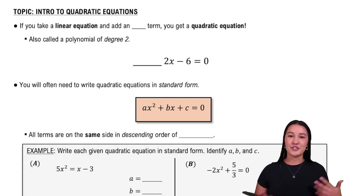
A quadratic equation is a second-degree polynomial equation in the form ax² + bx + c = 0, where a, b, and c are constants and a ≠ 0. It represents a parabola when graphed and can have zero, one, or two real solutions depending on the discriminant.
추천 영상:
5:35
Introduction to Quadratic Equations

Quadratic Formula

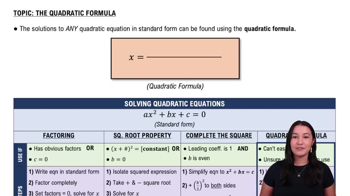
The quadratic formula x = (-b ± √(b² - 4ac)) / (2a) provides the solutions to any quadratic equation ax² + bx + c = 0. It uses the coefficients a, b, and c to calculate the roots, including complex solutions when the discriminant is negative.
추천 영상:
6:36
Quadratic Formula

Discriminant

The discriminant, given by Δ = b² - 4ac, determines the nature of the roots of a quadratic equation. If Δ > 0, there are two distinct real roots; if Δ = 0, one real root; and if Δ < 0, two complex conjugate roots.