Skip to main content
Macroeconomics
My Course
Learn
Exam Prep
AI Tutor
Study Guides
Flashcards
Explore
Try the app
My Course
Learn
Exam Prep
AI Tutor
Study Guides
Flashcards
Explore
Try the app
Back
AE Model: Algebraic Approach definitions
You can tap to flip the card.
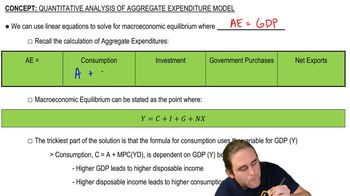
Aggregate Expenditures
You can tap to flip the card.
👆
Aggregate Expenditures
Total planned spending in an economy, including consumption, investment, government spending, and net exports.
Track progress
Control buttons has been changed to "navigation" mode.
1/13
Related flashcards
Related practice
Recommended videos
AE Model: Algebraic Approach quiz
AE Model: Algebraic Approach
15 Terms
AE Model: Algebraic Approach
15. Deriving the Aggregate Expenditures Model
10 problems
Topic
Deriving the Multiplier Algebraically
15. Deriving the Aggregate Expenditures Model
10 problems
Topic
16. Deriving the Aggregate Expenditures Model
7 topics
13 problems
Chapter
Guided course
04:46
Aggregate Expenditures
1466
views
17
rank
Guided course
02:20
Algebraic Approach to the AE Model
1513
views
14
rank
Terms in this set (13)
Hide definitions
Aggregate Expenditures
Total planned spending in an economy, including consumption, investment, government spending, and net exports.
Macroeconomic Equilibrium
The point where total spending matches total output, ensuring no unplanned changes in inventories.
Linear Equation
A mathematical expression showing a straight-line relationship, used to model aggregate expenditures and GDP.
Consumption
Spending by households, calculated as a base amount plus a portion of income determined by the marginal propensity to consume.
Investment
Expenditures by businesses on capital goods, treated as a constant in the aggregate expenditures model.
Government Spending
Purchases of goods and services by the public sector, considered a fixed component in equilibrium calculations.
Net Exports
The value of exports minus imports, representing the international sector's contribution to aggregate expenditures.
GDP
The total market value of all final goods and services produced within a country, denoted as Y in equations.
Marginal Propensity to Consume
The fraction of additional income that households spend on consumption, influencing the slope of the consumption function.
Disposable Income
Income available to households after taxes, often approximated as total income in equilibrium calculations.
Base Consumption
The minimum level of household spending that occurs even when income is zero.
Equilibrium Equation
The algebraic statement Y = C + I + G + NX, used to solve for the output level where spending equals production.
Interdependence
The mutual relationship where changes in output affect consumption, which in turn influences total expenditures.
 BackBack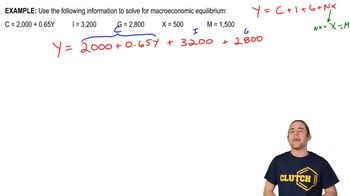
 04:46
04:46