Skip to main content
Macroeconomics
My Course
Learn
Exam Prep
AI Tutor
Study Guides
Flashcards
Explore
Try the app
My Course
Learn
Exam Prep
AI Tutor
Study Guides
Flashcards
Explore
Try the app
Back
Austrian Model definitions
You can tap to flip the card.
Austrian Model
You can tap to flip the card.
👆
Austrian Model
An early economic framework favoring free markets over government planning, emphasizing cycles driven by central bank policies.
Track progress
Control buttons has been changed to "navigation" mode.
1/14
Related flashcards
Related practice
Recommended videos
Austrian Model quiz
Austrian Model
15 Terms
Austrian Model
22. Macroeconomic Schools of Thought
10 problems
Topic
Communism and Karl Marx
22. Macroeconomic Schools of Thought
10 problems
Topic
24. Macroeconomic Schools of Thought
7 topics
15 problems
Chapter
Guided course
03:31
Austrian Model
768
views
6
rank
Terms in this set (14)
Hide definitions
Austrian Model
An early economic framework favoring free markets over government planning, emphasizing cycles driven by central bank policies.
Free Market System
An economic environment where prices and production are determined by voluntary exchanges with minimal government intervention.
Government Planning
A system where authorities direct economic activity, including production and investment decisions, rather than relying on market forces.
Business Cycle
A recurring pattern of economic expansions and recessions, marked by fluctuations in output and employment.
Expansion
A phase in the economy characterized by rising output, investment, and employment, typically following a recession.
Recession
A period of economic decline marked by reduced investment, output, and employment, often following an expansion.
Central Bank
An institution responsible for managing a nation's monetary policy, including setting interest rates that influence economic activity.
Interest Rate
The cost of borrowing money, set by monetary authorities, which affects investment and consumption decisions.
Investment
The allocation of resources by firms or individuals to acquire assets or capital goods, aiming to generate future returns.
Production
The process of creating goods or services, often increased during economic expansions due to higher investment.
Housing Market
A sector where residential properties are bought and sold, sensitive to changes in borrowing costs and investment trends.
Bubble
A rapid escalation in asset prices, such as real estate, driven by excessive investment and often followed by a sharp decline.
Great Recession
A severe global economic downturn from 2007 to 2009, triggered by a collapse in the housing market after a period of low interest rates.
Keynesian Model
A framework emphasizing government intervention to manage economic cycles, contrasting with free-market approaches.
 BackBack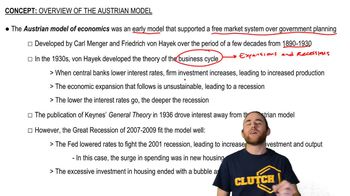
 03:31
03:31