Skip to main content
Macroeconomics
My Course
Learn
Exam Prep
AI Tutor
Study Guides
Flashcards
Explore
Try the app
My Course
Learn
Exam Prep
AI Tutor
Study Guides
Flashcards
Explore
Try the app
Back
Elasticity Summary definitions
You can tap to flip the card.
Price Elasticity of Demand
You can tap to flip the card.
👆
Price Elasticity of Demand
Ratio of percentage change in quantity demanded to percentage change in price, always expressed as a positive value.
Track progress
Control buttons has been changed to "navigation" mode.
1/15
Related flashcards
Related practice
Recommended videos
Elasticity Summary quiz
Elasticity Summary
15 Terms
Elasticity Summary
4. Elasticity
9 problems
Topic
Price Elasticity of Supply on a Graph
4. Elasticity
10 problems
Topic
4. Elasticity - Part 1 of 2
10 topics
15 problems
Chapter
4. Elasticity - Part 2 of 2
1 topic
3 problems
Chapter
Guided course
04:06
Elasticity Summary
4008
views
31
rank
Terms in this set (15)
Hide definitions
Price Elasticity of Demand
Ratio of percentage change in quantity demanded to percentage change in price, always expressed as a positive value.
Price Elasticity of Supply
Ratio of percentage change in quantity supplied to percentage change in price, using absolute values for results.
Income Elasticity of Demand
Measures how quantity demanded responds to changes in income; sign indicates if a good is normal or inferior.
Cross Price Elasticity of Demand
Shows how quantity demanded of one good changes with the price of another; sign reveals substitutes or complements.
Midpoint Method
Calculation technique using averages of starting and ending values to find percentage changes for elasticity.
Normal Good
Type of good for which demand increases as consumer income rises, indicated by a positive income elasticity.
Inferior Good
Type of good for which demand decreases as consumer income rises, shown by a negative income elasticity.
Substitute
Good with positive cross price elasticity, meaning demand rises when the price of another good increases.
Complement
Good with negative cross price elasticity, meaning demand falls when the price of another good increases.
Unit Elasticity
Situation where percentage change in quantity equals percentage change in price, maximizing total revenue.
Elastic Demand
Condition where elasticity value exceeds one, indicating quantity demanded changes more than price.
Inelastic Demand
Condition where elasticity value is less than one, indicating quantity demanded changes less than price.
Total Revenue
Product of price and quantity sold, affected by elasticity when price changes.
Straight Line Demand Curve
Graphical representation where elasticity varies along the curve, with a midpoint indicating unit elasticity.
Absolute Value
Mathematical approach ensuring elasticity calculations are positive, especially for price elasticity measures.
 BackBack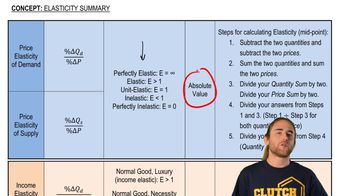
 04:06
04:06