Skip to main content
Macroeconomics
My Course
Learn
Exam Prep
AI Tutor
Study Guides
Flashcards
Explore
Try the app
My Course
Learn
Exam Prep
AI Tutor
Study Guides
Flashcards
Explore
Try the app
Back
Long Run Aggregate Supply definitions
You can tap to flip the card.
Long Run Aggregate Supply
You can tap to flip the card.
👆
Long Run Aggregate Supply
A vertical line on the AD-AS graph representing the maximum sustainable output an economy can produce when all resources are fully utilized.
Track progress
Control buttons has been changed to "navigation" mode.
1/15
Related flashcards
Related practice
Recommended videos
Long Run Aggregate Supply quiz #1
Long Run Aggregate Supply
10 Terms
Long Run Aggregate Supply
16. Aggregate Demand and Aggregate Supply Analysis
10 problems
Topic
Short Run Aggregate Supply
16. Aggregate Demand and Aggregate Supply Analysis
10 problems
Topic
17. Aggregate Demand and Aggregate Supply Analysis
8 topics
15 problems
Chapter
Guided course
04:36
Long Run Aggregate Supply
2749
views
57
rank
Guided course
04:35
Shifting Long Run Aggregate Supply
2256
views
68
rank
Terms in this set (15)
Hide definitions
Long Run Aggregate Supply
A vertical line on the AD-AS graph representing the maximum sustainable output an economy can produce when all resources are fully utilized.
Real GDP
The total value of goods and services produced, adjusted for inflation, reflecting actual output rather than price changes.
Factors of Production
Inputs like labor, capital, natural resources, and technology that determine the productive capacity of an economy.
Labor
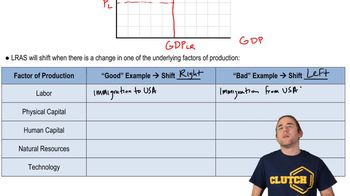
The workforce available for producing goods and services, influenced by population changes such as immigration or emigration.
Physical Capital
Tangible assets like factories and equipment used to produce goods and services, impacting productivity and output.
Human Capital
The skills, education, and abilities of workers, which enhance productivity and can be increased through education.
Natural Resources
Raw materials such as oil, lumber, or minerals available for production, affecting an economy's output potential.
Technology
Innovations and advancements that improve efficiency and productivity, often shifting output capacity upward.
Price Level
A measure of average prices in the economy, which does not influence long-run output but is shown on the AD-AS graph.
Full Employment
A situation where all available resources are utilized, representing the economy's maximum sustainable output.
AD-AS Model
A framework using aggregate demand and aggregate supply curves to analyze output and price level interactions.
Vertical Line
A graphical representation indicating that output does not change with price level in the long run.
Shift Right
An increase in productive capacity, shown by the LRAS curve moving outward due to more resources or better technology.
Shift Left
A decrease in productive capacity, shown by the LRAS curve moving inward due to loss of resources or other negative factors.
Long Run Equilibrium
A state where aggregate demand and long-run aggregate supply intersect, indicating stable output at full resource utilization.
 BackBack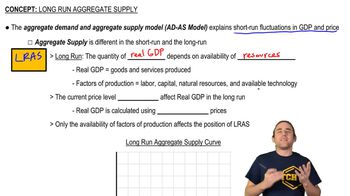
 04:36
04:36