Skip to main content
Macroeconomics
My Course
Learn
Exam Prep
AI Tutor
Study Guides
Flashcards
Explore
Try the app
My Course
Learn
Exam Prep
AI Tutor
Study Guides
Flashcards
Explore
Try the app
Back
Risk and Diversification definitions
You can tap to flip the card.
Diversification
You can tap to flip the card.
👆
Diversification
A strategy involving holding a variety of investments to reduce exposure to risks unique to individual assets.
Track progress
Control buttons has been changed to "navigation" mode.
1/15
Related flashcards
Related practice
Recommended videos
Risk and Diversification quiz
Risk and Diversification
15 Terms
Risk and Diversification
13. The Financial System
9 problems
Topic
Time Value of Money Calculations
13. The Financial System
9 problems
Topic
14. The Financial System - Part 1 of 2
8 topics
15 problems
Chapter
13. The Financial System - Part 2 of 2
1 topic
3 problems
Chapter
Guided course
04:01
Efficient Markets Theory, Random Walk, and Irrational Behavior
835
views
6
rank
Guided course
05:40
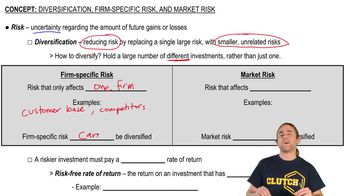
Market Risk and Firm-specific Risk
964
views
8
rank
Terms in this set (15)
Hide definitions
Diversification
A strategy involving holding a variety of investments to reduce exposure to risks unique to individual assets.
Firm-Specific Risk
Uncertainty affecting only a single company, often due to factors like competition or customer changes.
Market Risk
Uncertainty impacting the entire financial system, such as recessions or wars, which cannot be avoided by spreading investments.
Treasury Bills
Short-term government securities considered nearly free of default risk, often used as a benchmark for safe returns.
Rate of Return
A measure calculated by dividing investment income, such as dividends or interest, by the purchase price.
Dividends
Payments made to shareholders from a company's profits, representing a portion of the income earned from owning stock.
Capital Gains
Profits realized from selling an asset at a higher price than its purchase cost, contributing to investment returns.
Interest
Earnings received from lending money or holding bonds, typically paid at regular intervals.
Efficient Market Hypothesis
A theory stating that asset prices reflect all publicly available information, making future price movements unpredictable.
Informational Efficiency
A market condition where prices instantly incorporate all relevant public data, leaving no advantage for informed trading.
Random Walk
A pattern where asset prices move unpredictably due to the arrival of unforeseen information.
Speculation
Engagement in high-risk investments with the hope of profiting from short-term market fluctuations.
Economic Bubble
A situation where asset prices inflate rapidly due to excessive demand and optimism, often followed by a sharp decline.
FOMO
A psychological driver in markets where investors buy assets out of fear of missing potential gains seen by others.
Recession
A significant decline in economic activity across the market, often leading to widespread drops in asset values.
 BackBack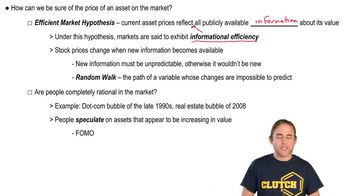
 04:01
04:01