What does the consumption function show in macroeconomics?
It shows the relationship between disposable income and consumption, indicating that as disposable income increases, consumption also increases.
What is disposable income?
Disposable income is the money households have left after paying taxes, which can be used for either consumption or saving.
What does the 45-degree line represent on a consumption function graph?
It represents a scenario where every dollar of disposable income is consumed, serving as a reference point for the actual consumption function.
Why does the consumption function start from a positive intercept on the consumption axis?
Because households have basic consumption needs even when disposable income is zero, such as food and shelter.
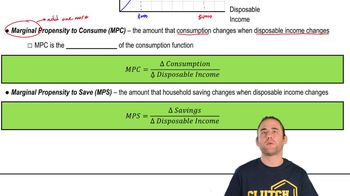
What is the marginal propensity to consume (MPC)?
MPC is the ratio of the change in consumption to the change in disposable income, showing how much of additional income will be spent.
What is the marginal propensity to save (MPS)?
MPS is the portion of additional disposable income that is saved, and together with MPC, always adds up to 1.
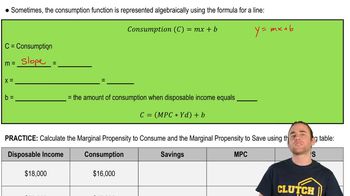
How is the consumption function similar to the equation y = mx + b?
In the consumption function, 'm' (the slope) is the MPC, 'x' is disposable income, and 'b' is the intercept representing consumption when income is zero.
What does the area between the 45-degree line and the consumption function represent?
It represents the amount of disposable income that is saved rather than consumed.
What does it mean if a point on the consumption function is above the 45-degree line?
It means households are consuming more than their disposable income, resulting in dis-saving or borrowing.
If the MPC is 0.75, what is the MPS?
The MPS would be 0.25, since MPC + MPS must equal 1.
How does the consumption function help us understand national income use?
It helps us gauge how much of national disposable income is consumed versus saved at different income levels.
What happens to consumption when disposable income increases?
Consumption increases, but not necessarily by the full amount of the income increase; some may be saved.
What is the formula for the marginal propensity to consume?
MPC = Change in Consumption / Change in Disposable Income.
Why is the slope of the consumption function important?
The slope represents the MPC, showing how much consumption changes with each additional dollar of disposable income.
What does the intercept 'b' in the consumption function equation represent?
It represents the level of consumption when disposable income is zero, reflecting basic consumption needs.
 Back
Back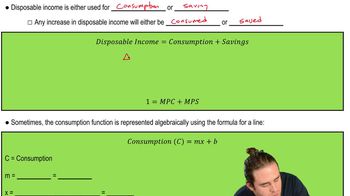
 02:45
02:45