Microeconomics
What happens to deadweight loss when a tax is imposed on a market?
How is tax revenue represented on a supply and demand graph after a tax is imposed?
How can deadweight loss be used to assess the efficiency loss in a market due to taxation?
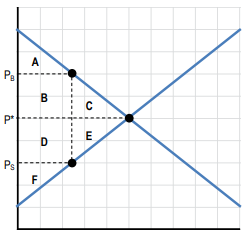
Before a tax is imposed, consumer surplus is represented by areas A, B, and C, and producer surplus by D, E, and F. After a tax, consumer surplus is A and producer surplus is F. What are the changes in surplus areas?
If a per unit tax of \$3 is imposed on a market and the quantity exchanged after the tax is 100 units, what is the total tax revenue generated?
In a market with a tax, how is tax revenue represented in terms of consumer and producer surplus?
On a supply and demand graph, if the price is \$15 and the supply curve is below the price, what area represents the producer surplus?
Which of the following best defines deadweight loss in the context of taxation?
What happens to a market when a tax is imposed, and how does it affect economic surplus?
A market has a per unit tax of \$5, and the quantity exchanged after the tax is 200 units. Calculate the tax revenue generated.