What does the aggregate expenditures (AE) model illustrate in macroeconomics?
The AE model illustrates macroeconomic equilibrium where aggregate expenditures equal real GDP, shown by the intersection of the AE line and the 45-degree line.
What components make up aggregate expenditures (AE)?
Aggregate expenditures consist of consumption (C), investment (I), government purchases (G), and net exports (NX).
How is consumption (C) modeled in the AE model?
Consumption is modeled as C = A + cY, where A is autonomous consumption and c is the marginal propensity to consume.
What does the marginal propensity to consume (c) represent?
It represents the fraction of each additional dollar of income that is spent on consumption.
What effect do constant investment, government spending, and net exports have on the AE line?
They shift the AE line upward, increasing the y-intercept but not changing the slope.
On the AE graph, what is plotted on the x-axis and y-axis?
GDP (Y) is plotted on the x-axis, and aggregate expenditures (AE) are plotted on the y-axis.
What is the significance of the 45-degree line in the AE model graph?
The 45-degree line shows all points where aggregate expenditures equal GDP, indicating macroeconomic equilibrium.
How do you find macroeconomic equilibrium using the AE graph?
Equilibrium is found where the aggregate expenditures line crosses the 45-degree line.
What happens to the consumption function when investment is added?
Adding investment shifts the consumption function upward, increasing the y-intercept but keeping the same slope.
How does adding government purchases affect the AE line?
Adding government purchases further shifts the AE line upward, again increasing the y-intercept.
What is the final equation for aggregate expenditures after adding all components?
The final AE equation is AE = C + I + G + NX.
If the marginal propensity to consume is 0.5, what does this mean?
It means that for every extra dollar of income, half is spent on consumption and half is saved.
Why is there consumption even when income (GDP) is zero?
Because autonomous consumption (A) represents necessary spending for basic needs, regardless of income.
What does a parallel shift of the AE line indicate?
A parallel shift indicates an increase in spending from investment, government purchases, or net exports, without changing the slope.
What is the 'magic number' for equilibrium GDP in the example given, and why?
The equilibrium GDP is 8,000,000,000, because at this level, aggregate expenditures equal production, indicating macroeconomic equilibrium.
 Back
Back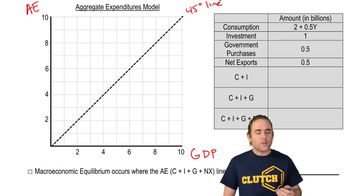
 13:28
13:28