Skip to main content
Microeconomics
My Course
Learn
Exam Prep
AI Tutor
Study Guides
Flashcards
Explore
Try the app
My Course
Learn
Exam Prep
AI Tutor
Study Guides
Flashcards
Explore
Try the app
Back
Average Propensity to Consume and Save definitions
You can tap to flip the card.
Average Propensity to Consume
You can tap to flip the card.
👆
Average Propensity to Consume
Ratio showing total consumption relative to disposable income, indicating how much income is spent rather than saved.
Track progress
Control buttons has been changed to "navigation" mode.
1/13
Related flashcards
Recommended videos
Average Propensity to Consume and Save quiz
Average Propensity to Consume and Save
15 Terms
Guided course
01:50
Average Propensity to Consume and Save
5
views
Terms in this set (13)
Hide definitions
Average Propensity to Consume
Ratio showing total consumption relative to disposable income, indicating how much income is spent rather than saved.
Average Propensity to Save
Ratio showing total savings relative to disposable income, revealing the portion of income not used for consumption.
Marginal Propensity to Consume
Measure of how much additional consumption occurs from an extra dollar of income, reflecting incremental spending behavior.
Marginal Propensity to Save
Measure of how much additional saving occurs from an extra dollar of income, indicating incremental saving behavior.
Disposable Income
Income remaining after taxes, available for spending or saving, forming the basis for calculating consumption and savings rates.
Consumption
Total amount of income used for purchasing goods and services, central to analyzing spending patterns.
Savings
Total portion of income not spent, set aside for future use, crucial for understanding financial behavior.
Income Elasticity of Demand
Concept describing how changes in income affect the quantity demanded of goods, linked to consumer behavior.
Market Equilibrium
State where supply and demand balance, influenced by consumer spending and saving decisions.
Opportunity Cost
Value of the next best alternative forgone when choosing between consumption and saving.
Incentives
Factors motivating individuals to allocate disposable income toward consumption or savings.
Rates of Consumption
Proportion of disposable income spent, used to analyze economic activity and consumer choices.
Rates of Savings
Proportion of disposable income saved, important for understanding financial stability and future planning.
 BackBack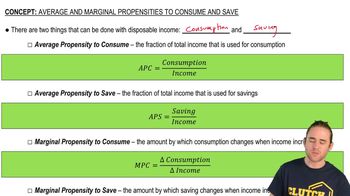
 01:50
01:50