What does the long-run average total cost (LRATC) curve show?
The LRATC curve shows the lowest possible average total cost for each output level when all inputs are variable, illustrating economies of scale, constant returns to scale, and diseconomies of scale as output changes.
Which of the graphs typically represents an average total cost curve?
A typical average total cost curve is U-shaped, decreasing at first due to economies of scale, flattening out at constant returns to scale, and then increasing due to diseconomies of scale.
How is the average total cost curve generally shaped?
The average total cost curve is generally U-shaped, reflecting initial decreases in cost, a flat section, and eventual increases as output rises.
Average total cost is increasing whenever:
Average total cost is increasing whenever diseconomies of scale occur, meaning further increases in output lead to higher average total costs due to inefficiencies like coordination problems.
In the short run, why can't a firm immediately change its factory size or lease agreements?
Because these are fixed costs resulting from past decisions, and there isn't enough time to reevaluate or alter them in the short run.
What does the minimum efficient scale represent on the long-run average total cost curve?
It represents the output level where economies of scale end and constant returns to scale begin, marking the lowest cost before further increases in output no longer reduce average total cost.
How does specialization contribute to economies of scale in the long run?
Specialization allows workers to focus on specific tasks, increasing efficiency and reducing average total cost as output rises.
Why might a very large factory experience diseconomies of scale?
A very large factory may face coordination problems and management inefficiencies, causing average total cost to rise as output increases.
What happens to all costs in the long run compared to the short run?
In the long run, all costs become variable, allowing firms to adjust decisions like factory size and production capacity.
How is the long-run average total cost curve constructed from short-run average total cost curves?
It is formed by tracing the lowest points of all possible short-run average total cost curves, showing the minimum cost achievable at each output level.
 Back
Back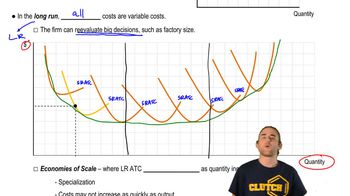
 13:13
13:13