Monopolistically competitive markets are characterized by...
Many firms, differentiated products, and free entry and exit.
In the short run, a firm operating in a monopolistically competitive market...
Can earn positive, negative, or zero economic profit.
When entry occurs in a monopolistically competitive industry...
Economic profits are reduced and eventually eliminated.
Monopolistically competitive product markets are inefficient because...
Firms do not produce at minimum average cost and have excess capacity.
What is the drawback of monopolistic competition?
It leads to inefficiency and higher prices compared to perfect competition.
How does product differentiation give firms in monopolistic competition some control over pricing?
Product differentiation makes each firm's product unique, allowing them to set prices above marginal cost and have some market power compared to perfect competition.
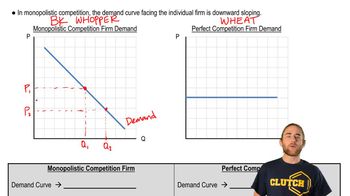
Why is the demand curve for a firm in monopolistic competition downward sloping?
The demand curve is downward sloping because firms must lower their price to sell more units, reflecting consumers' willingness to buy more at lower prices.
What happens to marginal revenue when a monopolistically competitive firm increases its output?
Marginal revenue decreases as output increases because the firm must lower its price to sell additional units, unlike in perfect competition.
How do barriers to entry in monopolistic competition compare to those in monopoly?
Barriers to entry are low in monopolistic competition, allowing free entry and exit, while monopolies often have significant barriers preventing new firms from entering.
Can substitute goods in monopolistic competition include products that are not identical to the firm's product?
Yes, substitute goods can include products that are similar but not identical, such as pizza being a substitute for a hamburger in a food court.
 Back
Back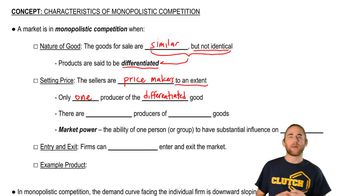
 05:53
05:53