Pearson+ LogoPearson+ Logo
Back

Characteristics of Monopoly quiz #3

Control buttons has been changed to "navigation" mode.
1/11
  • Monopolies and monopolistically competitive firms differ in that monopolies

    Have no close substitutes and face no competition.
  • One way in which monopolistic competition and monopoly differ is that:

    Monopolistic competition has many firms; monopoly has one.
  • A monopoly differs from monopolistic competition in that

    A monopoly has no close substitutes; monopolistic competition has differentiated products.
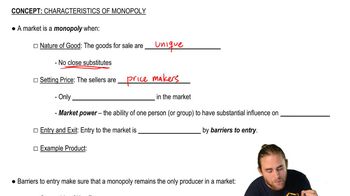
  • Classify each statement according to whether or not it describes a monopoly.

    Describes monopoly: single seller, price maker, barriers to entry. Does not describe monopoly: many sellers, free entry.
  • In monopolistic competition, _______ set the prices in the market.

    Individual firms.
  • Conglomerate mergers differ from horizontal mergers because

    Conglomerate mergers combine firms in unrelated industries; horizontal mergers combine competitors.
  • A pure monopoly is a price engaging in non-price competition.

    A pure monopoly is a price maker and may engage in non-price competition such as advertising.
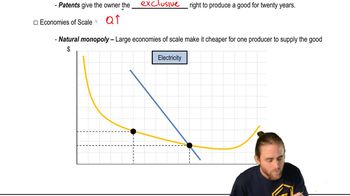
  • L&P Power is a natural monopoly. Why?

    It supplies electricity efficiently due to high fixed costs and economies of scale.
  • A purely monopolistic firm has what market power?

    It can set prices and restrict output due to lack of competition.
  • What happens to a monopoly's marginal revenue when it increases output?

    A monopoly must lower its price to sell more units, so its marginal revenue decreases as output increases, unlike in perfect competition where price equals marginal revenue.
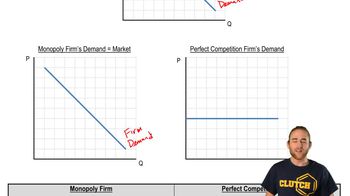
  • What is the shape of the demand curve facing a monopolist, and how does it differ from the demand curve in perfect competition?

    The demand curve facing a monopolist is always downward sloping, reflecting the entire market demand for the unique good they supply. This differs from perfect competition, where individual firms face a perfectly elastic (horizontal) demand curve.