Oligopolies can be classified as homogeneous (identical products, e.g., aluminum) and differentiated (products differ, e.g., soft drinks like Coke and Pepsi).
Why is the automobile industry considered an oligopoly?
The automobile industry is considered an oligopoly because it is dominated by a few large firms, each with significant market power and interdependence in pricing and output decisions.
Which best describes how advertising influences consumer choice in an oligopoly?
Advertising in an oligopoly can differentiate products and influence consumer preferences, often leading to increased brand loyalty and limited consumer choice among a few major brands.
When does an oligopoly exist in a market?
An oligopoly exists when a market is dominated by a few producers who are interdependent and face barriers to entry.
What is true about oligopolies?
Oligopolies are characterized by a few firms with significant market power and interdependent decision-making.
Why is competition limited in an oligopoly?
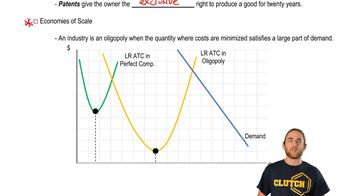
Competition is limited in an oligopoly due to barriers to entry, such as ownership of key resources, government regulation, and economies of scale.
Why is collusion desirable to oligopolistic firms?
Collusion allows oligopolistic firms to coordinate pricing and output, increasing profits by reducing competition.
What are the positive effects of large oligopolists advertising?
Large oligopolists' advertising can increase brand awareness, differentiate products, and potentially expand market share.
In an oligopoly, how do firms interact?
Firms in an oligopoly are interdependent, meaning each firm's decisions affect and are affected by the actions of other firms.
In the framework of an oligopoly, what is a key feature of firm behavior?
A key feature is strategic decision-making, where firms consider competitors' likely responses to their actions.
What condition would most likely create the setting for an oligopoly?
High barriers to entry would most likely create the setting for an oligopoly.
What is incorrect about the statement that oligopolies have many sellers?
The statement 'there are many sellers' is not correct; oligopolies have few sellers.
What are three models used to study pricing and output by oligopolies?
Three models are the Cournot model, Bertrand model, and Stackelberg model.
When two firms interact in an oligopolistic market, what is a likely outcome?
Their pricing and output decisions are interdependent, often leading to strategic behavior such as matching price changes.
Which industry is an example of an oligopoly market?
The soft drink industry (e.g., Coke and Pepsi) illustrates an oligopoly market.
What characteristic is prevalent in oligopolies?
Interdependence is prevalent in oligopolies.
Which industry illustrates a homogeneous oligopoly?
Aluminum is an illustration of a homogeneous oligopoly.
Is it true that products in an oligopoly are always identical?
The statement 'products are always identical' is false; products can be identical or differentiated.
Which firm would an economist most likely label as an oligopolist: a local bakery, a major aluminum producer, a small farm, a single utility company?
A major aluminum producer would most likely be labeled as an oligopolist.
Which industry is the best example of an oligopoly?
Aluminum production is the best example of oligopoly.
Which product category is the best example of an oligopoly?
Soft drinks (e.g., Coke and Pepsi) are a classic example of an oligopoly product category.
What are the characteristics that apply to oligopoly industries?
All of these apply: few firms, barriers to entry, interdependence, and identical or differentiated products.
What are the characteristics of oligopolistic markets?
Few producers, interdependence, barriers to entry, and products that may be identical or differentiated.
What is an oligopoly?
An oligopoly is a market structure with a few producers who are interdependent and face barriers to entry.
Which situation could be the best example of an oligopoly?
A market where a few large firms dominate, such as the soft drink or aluminum industry.
What is an oligopoly? Part 2: An oligopoly is a market structure with what features?
An oligopoly is a market structure with few producers, interdependence, and barriers to entry.
What characterizes a market with oligopolistic competition?
Few firms, interdependent decision-making, and significant barriers to entry.
When an oligopoly exists, how many producers dominate the market: none, one, a few, many?
A few producers dominate the market in an oligopoly.
Oligopolies are not a desirable market structure because they achieve what outcome?
Oligopolies may lead to reduced competition, higher prices, and less consumer choice compared to more competitive markets.
An oligopoly firm is similar to a monopolistically competitive firm in that both
Both have some control over price and may sell differentiated products.
What market structure is described by having few sellers?
Few sellers describes an oligopoly.
What is an oligopoly? Part 2: An oligopoly is a market structure with what characteristics?
Few producers, interdependence, and barriers to entry.
A market structure in which only a few sellers offer a similar product is called a
Oligopoly.
In an oligopolistic market, consumer choice is nonexistent, limited, extensive, or infinite?
Consumer choice is limited in an oligopolistic market.
Why is the automobile industry considered an oligopoly?
Because a few large firms dominate the market and are interdependent in their decisions.
What are two key characteristics of an oligopoly?
Few sellers and interdependent decision-making exist in an oligopoly.
In the framework of an oligopoly, what strategy can work like a silent form of cooperation?
Price leadership, where one firm sets the price and others follow, can act as a silent form of cooperation.
How do firms in an oligopolistic market interact strategically?
Each firm's decisions affect the other, leading to strategic behavior and possible price matching.
What generally causes U.S. companies in oligopoly to have similar prices?
Interdependence and strategic behavior, such as price matching, often result in similar prices.
 Back
Back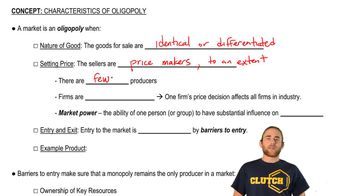
 04:45
04:45