Skip to main content
Microeconomics
My Course
Learn
Exam Prep
AI Tutor
Study Guides
Flashcards
Explore
Try the app
My Course
Learn
Exam Prep
AI Tutor
Study Guides
Flashcards
Explore
Try the app
Back
Characteristics of Perfect Competition quiz #1
You can tap to flip the card.
What is not a characteristic of a perfectly competitive market?
You can tap to flip the card.
👆
What is not a characteristic of a perfectly competitive market?
Product differentiation is not a characteristic of a perfectly competitive market.
Track progress
Control buttons has been changed to "navigation" mode.
1/38
Related flashcards
Related practice
Recommended videos
Characteristics of Perfect Competition quiz #2
Characteristics of Perfect Competition
10 Terms
Characteristics of Perfect Competition definitions
Characteristics of Perfect Competition
13 Terms
Characteristics of Perfect Competition
11. Perfect Competition
10 problems
Topic
Revenue in Perfect Competition
11. Perfect Competition
10 problems
Topic
11. Perfect Competition
11 topics
15 problems
Chapter
Guided course
02:29
Characteristics of Perfect Competition
3685
views
69
rank
Guided course
03:57
Market Demand and Individual Firm Demand
3026
views
94
rank
Terms in this set (38)
Hide definitions
What is not a characteristic of a perfectly competitive market?
Product differentiation is not a characteristic of a perfectly competitive market.
What is pure competition?
Pure competition is a market structure with many buyers and sellers, identical products, and free entry and exit, where firms are price takers.
What is characteristic of a purely competitive seller's demand curve?
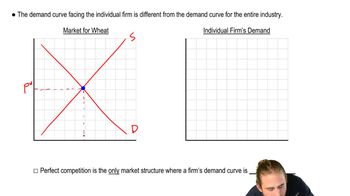
A purely competitive seller faces a perfectly elastic (horizontal) demand curve at the market price.
What best illustrates the definition of a sole proprietorship in market structures?
A single individual owning and operating a small business, such as a local bakery.
What characteristic does not describe a perfectly competitive market?
Barriers to entry do not describe a perfectly competitive market.
What is true of a firm in a perfectly competitive industry?
A firm in a perfectly competitive industry is a price taker and cannot influence the market price.
Why do single firms in perfectly competitive markets face horizontal demand curves?
Because each firm is a small part of the market and cannot influence the price, so it can sell any quantity at the market price.
Which firm is closest to being a perfectly competitive firm?
A wheat farmer is closest to being a perfectly competitive firm.
What is not a characteristic of the structure of perfectly competitive markets?
Unique or branded products are not a characteristic of perfectly competitive markets.
What is true about firms in perfect competition?
Firms in perfect competition are price takers and sell identical products.
If the firms do not collude in a perfectly competitive market, what is the result?
Firms act independently and cannot influence the market price.
What is true about buyers and sellers in a perfectly competitive market?
No single buyer or seller can influence the market price.
Which situation gives the best example of a price taker as it pertains to perfect competition?
A farmer selling wheat at the market price with no ability to set a different price.
What is a characteristic of a competitive price-taker market?
Firms accept the market price and cannot influence it.
What is true for firms in perfect competition regarding their products and pricing power?
Firms sell identical products and have no control over price.
Which of the given factors is an assumption of perfect competition?
Free entry and exit is an assumption of perfect competition.
What is an example of a perfectly competitive market?
The market for wheat is an example of perfect competition.
What characterizes perfectly competitive markets? Part 2: Perfectly competitive markets have...
Perfectly competitive markets have many buyers and sellers, identical products, and free entry and exit.
Which market structure is not associated with market power?
Perfect competition is not associated with market power.
Which condition is present in pure competition but missing in monopolistic competition?
Identical products are present in pure competition but not in monopolistic competition.
What is true for firms and products in a perfectly competitive market?
Firms are price takers and products are identical.
What is not a condition for perfect competition?
Limited entry and exit is not a condition for perfect competition.
What is a characteristic of perfectly competitive markets?
A large number of buyers and sellers is a characteristic of perfectly competitive markets.
Which statement describes the variety of goods found in perfect/pure competition?
Goods are identical and there is no variety in perfect competition.
What is true under conditions of perfect competition?
Firms cannot influence the market price and must accept it.
What are examples of perfectly competitive markets?
Agricultural markets like wheat and foreign exchange markets are perfectly competitive.
A perfectly competitive firm does not try to raise its price above the market price because...
It would sell nothing if it raised its price above the market price.
The owner of a cooperative owns what in the context of market structures?
The owner of a cooperative owns a share of the business, which is collectively owned.
What is a characteristic of perfectly competitive markets?
Free entry and exit is a characteristic of perfectly competitive markets.
Perfect competition is characterized by...
Many buyers and sellers, identical products, and free entry and exit.
Why is pure competition considered an unsustainable system?
Pure competition can be unsustainable if profits fall to zero, discouraging firms from remaining in the market.
If a perfectly competitive firm is a price taker, then...
It must accept the market price and cannot set its own price.
A perfectly competitive market has ________.
A perfectly competitive market has many buyers and sellers, identical products, and free entry and exit.
Why do firms in a perfectly competitive market have no market power?
Firms sell identical products and are small relative to the market.
Which of these is not a characteristic of pure competition?
Product differentiation is not a characteristic of pure competition.
A purely competitive seller is...
A price taker who sells identical products at the market price.
A perfectly competitive industry is characterized by...
A large number of firms, identical products, and free entry and exit.
In both perfect competition and monopolistic competition, each firm...
Each firm acts independently in setting output, but only in perfect competition are products identical.
 BackBack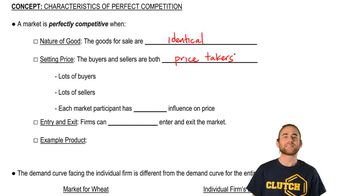
 02:29
02:29