Skip to main content
Microeconomics
My Course
Learn
Exam Prep
AI Tutor
Study Guides
Flashcards
Explore
Try the app
My Course
Learn
Exam Prep
AI Tutor
Study Guides
Flashcards
Explore
Try the app
Back
Circular Flow Diagram quiz #1
You can tap to flip the card.
Which statement best describes the circular flow model?
You can tap to flip the card.
👆
Which statement best describes the circular flow model?
The circular flow model illustrates the economic interactions between households and firms, showing how money and resources circulate through markets.
Track progress
Control buttons has been changed to "navigation" mode.
1/37
Related flashcards
Related practice
Recommended videos
Circular Flow Diagram definitions
Circular Flow Diagram
15 Terms
Circular Flow Diagram
0. Basic Principles of Economics
10 problems
Topic
Graphing Review
0. Basic Principles of Economics
10 problems
Topic
0. Basic Principles of Economics
13 topics
14 problems
Chapter
Guided course
01:32
Households and Firms
6250
views
79
rank
Guided course
04:20
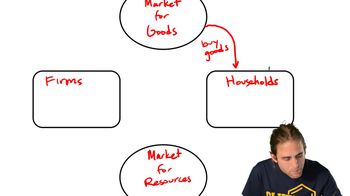
The Circular Flow Diagram
5735
views
131
rank
Terms in this set (37)
Hide definitions
Which statement best describes the circular flow model?
The circular flow model illustrates the economic interactions between households and firms, showing how money and resources circulate through markets.
How does income flow in the circular flow of income?
Income flows from firms to households in exchange for resources, and from households to firms in exchange for goods and services.
What are the components of the circular flow model?
Households, firms, the market for goods and services, and the market for resources.
According to the circular flow model, who owns the factors of production and who produces goods and services?
Households own the factors of production and sell them to firms, while firms produce goods and services for households.
What does the circular flow model represent?
It is a simplified representation of how money, goods, services, and resources move between households and firms in an economy.
In the circular flow model, what role do households play?
Households provide factors of production to firms and purchase goods and services from firms.
What is the most direct supply chain in a simple economy according to the circular flow model?
Households supply resources to firms, and firms supply goods and services to households.
In the circular-flow diagram, what do firms do?
Firms buy resources from households and sell goods and services to households.
What does the circular-flow diagram demonstrate about the relationship between households and firms?
It demonstrates the interdependence between households and firms through the exchange of money, goods, and resources.
What equality does the circular flow model illustrate?
The value of income earned by households and the value of expenditures on goods and services.
What is the flow of goods and services from the producer to the consumer called?
The product market flow.
According to the circular flow model of an economy, what do households do with resources and goods?
Households sell resources to firms and buy goods and services from firms.
How does money make the circular flow model more efficient?
Money facilitates exchanges between households and firms, making transactions easier and faster than barter.
In the simple circular-flow diagram, what do households do?
Households sell resources in the resource market and buy goods and services in the product market.
In the circular flow diagram, what do firms do?
Firms buy resources from households and sell goods and services to households.
According to the circular-flow model, how do households earn income?
Households earn income by selling factors of production to firms.
Study the circular flow models on pages 53 and 80. How are the two models different?
One model may include only households and firms, while the other may add government or foreign sectors, showing more complex flows.
Which situation best illustrates the role of households in the circular flow of goods?
Households purchase goods and services from firms in the product market.
What aspects of government involvement in the circular flow does the space program represent?
Government involvement can be shown as an additional sector that purchases resources and goods, influencing the flow of money and resources.
What do the colors of the arrows in the circular flow model represent?
Different colors typically represent the flow of money and the flow of goods, services, and resources.
The group of organizations that move products from the producer to consumers is a ______.
Supply chain or distribution channel.
In the circular flow model, households work and receive payment from firms. What is this payment called?
Income, such as wages, rent, or profit.
In the product market, households receive goods and services and pay firms for them.
True. Households buy goods and services from firms in the product market.
Based on this model, households earn income when they sell resources in factor markets.
True. Households earn income by selling labor, land, and capital in the factor market.
Based on this model, households earn income when they sell resources in markets for factors of production.
True. Households earn income by selling factors of production to firms.
The circular flow diagram of economic activity is a model of the interactions between which groups?
Households and firms.
Based on this model, households earn income when they sell resources to firms.
True. Households earn income by providing resources to firms.
In the circular-flow diagram, what is not considered a factor of production?
Money is not a factor of production; labor, land, and capital are.
In the circular flow model, firms are buyers in which market and sellers in which market?
Firms are buyers in the resource market and sellers in the product market.
Please label the circular flow diagram.
Label households, firms, product market, resource market, and indicate flows of money and goods/services.
Label each component of the circular flow diagram.
Components: Households, firms, product market, resource market, flows of money, flows of goods and resources.
The circular flow diagram of economic activity is a model of the:
Basic economic interactions between households and firms.
In the circular flow diagram model, what do the arrows represent?
Arrows represent the flow of money, goods, services, and resources between households and firms.
The two basic markets shown by the simple circular flow model are:
The market for goods and services and the market for resources.
In the circular flow model, what do households do?
Households sell resources to firms and buy goods and services from firms.
In the circular flow model, the market economy creates what?
A continuous flow of money, goods, services, and resources between households and firms.
The circular-flow model indicates that final goods are produced by which group?
Firms produce final goods and services.
 BackBack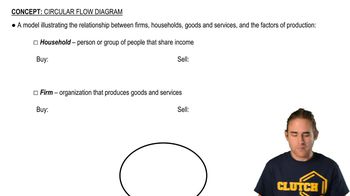
 01:32
01:32