Skip to main content
Microeconomics
My Course
Learn
Exam Prep
AI Tutor
Study Guides
Flashcards
Explore
Try the app
My Course
Learn
Exam Prep
AI Tutor
Study Guides
Flashcards
Explore
Try the app
Back
Communism and Karl Marx definitions
You can tap to flip the card.
Communist Model
You can tap to flip the card.
👆
Communist Model
Economic system critiquing free markets, emphasizing worker ownership and labor as the sole source of value.
Track progress
Control buttons has been changed to "navigation" mode.
1/15
Related flashcards
Recommended videos
Communism and Karl Marx quiz
Communism and Karl Marx
15 Terms
Guided course
05:32
Communism and Karl Marx
4
views
Terms in this set (15)
Hide definitions
Communist Model
Economic system critiquing free markets, emphasizing worker ownership and labor as the sole source of value.
Karl Marx
Philosopher and economist who developed a theory focusing on labor's role in value creation and worker exploitation.
Labor Theory of Value
Concept asserting that the worth of goods and services stems entirely from the labor invested in their production.
Means of Production
Factories, machines, and resources used to create goods, typically controlled by capitalists in traditional systems.
Capitalist
Individual or group owning production resources, profiting from worker labor without contributing to value creation.
Exploitation
Situation where workers receive wages below the value they generate, resulting in increased profits for owners.
Economic Inequality
Disparity in wealth and income between capitalists and workers, intensified by ownership concentration.
Revolution
Event where the working class seizes control of production resources, aiming to establish a new economic system.
Das Kapital
Seminal book by Karl Marx analyzing capitalist economies and laying the foundation for communist theory.
Monopoly
Market structure where a few firms dominate production, consolidating power and limiting competition.
Soviet Union
State formed after the Bolshevik revolution, attempting to implement communism but resulting in dictatorship and corruption.
Bolshevik Party
Political group responsible for the 1917 Russian revolution, leading to the creation of the Soviet Union.
Dictatorship
Political system characterized by centralized power and lack of democratic governance, often seen in communist attempts.
Government Failure
Inefficiency and corruption arising when state control replaces market mechanisms, hindering economic outcomes.
Perfect Competition
Market structure with many firms, no single entity controls prices or production, contrasting with monopoly and communism.
 BackBack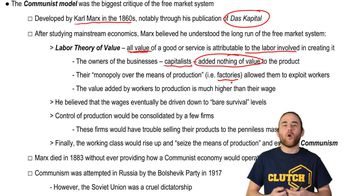
 05:32
05:32