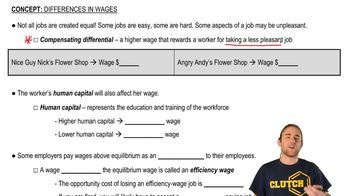
What is a compensating differential in the context of wages?
A compensating differential is extra pay offered to workers to compensate for unpleasant or risky aspects of a job.
Why might a construction worker earn more than someone in a less risky job?
A construction worker earns more due to the risks and unpleasant conditions, which require higher wages to attract workers.
How does the example of Nice Guy Nick and Angry Andy illustrate compensating differentials?
Angry Andy must pay higher wages than Nice Guy Nick because his unpleasant management style requires extra compensation for workers.
What is human capital?
Human capital refers to the education and training of the workforce, which increases their productivity and earning potential.
How does higher human capital affect wages?
Higher human capital typically leads to higher wages because more educated and trained workers are more productive.
What is an efficiency wage?
An efficiency wage is a wage paid above the equilibrium level to incentivize employees to work harder and reduce turnover.
Why might an employer pay an efficiency wage?
Employers pay efficiency wages to motivate employees to be more productive and to discourage them from leaving the job.
How does an efficiency wage affect the opportunity cost for employees?
Efficiency wages increase the opportunity cost of losing the job, making employees more motivated to perform well and keep their position.
What is meant by the derived demand for labor?
Derived demand for labor means that the demand for workers depends on the demand for the goods or services they produce.
Why do superstars like professional athletes earn such high wages?
Superstars earn high wages because there is high demand and low supply for their unique skills, and the goods they produce (like football games) are sold at high prices.
How does the market for high school teachers differ from that of professional athletes in terms of wages?
High school teachers earn less because there is a higher supply of qualified teachers and lower demand for their services compared to professional athletes.
What role does the value of the good produced play in determining wages?
Wages are higher when the goods produced are sold at high prices, as seen with professional sports, and lower when goods are sold at low prices, as with education.
Why might there be a surplus of applicants for efficiency wage jobs?
There is a surplus because efficiency wage jobs pay above equilibrium, attracting more applicants than there are positions available.
What happens to a worker if they lose an efficiency wage job?
If a worker loses an efficiency wage job, they may have to accept a lower-paying job, increasing the cost of losing their current position.
How does the supply of qualified workers affect equilibrium wages in different markets?
A lower supply of qualified workers, as with professional athletes, leads to higher wages, while a higher supply, as with teachers, leads to lower wages.
 Back
Back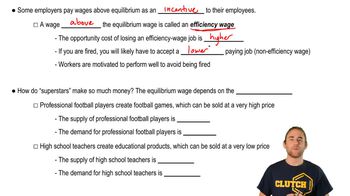
 04:12
04:12