Economic Surplus and Efficiency quiz #1 Flashcards

Economic Surplus and Efficiency quiz #1
Control buttons has been changed to "navigation" mode.
1/20
  • What is the best definition of economic data in the context of economic surplus and efficiency?
    Economic data refers to quantitative information about prices, quantities, consumer and producer behavior, and market outcomes used to analyze economic surplus and efficiency.
  • What do the indicators used by economists reveal about market efficiency?
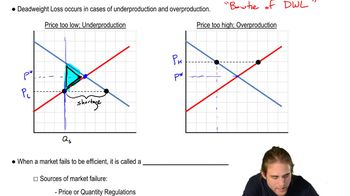
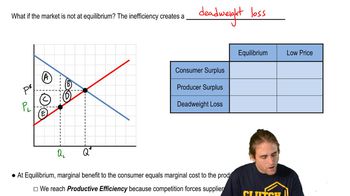
    Indicators such as consumer surplus, producer surplus, and deadweight loss reveal how efficiently a market allocates resources and whether it is operating at equilibrium.
  • What is the total surplus if Bashir buys a unit from Chander at market equilibrium?
    The total surplus is the sum of Bashir's consumer surplus and Chander's producer surplus for that transaction, maximized at market equilibrium.
  • Which best describes economic costs in the context of market efficiency?
    Economic costs include both explicit costs and opportunity costs, representing the total resources used in production and their best alternative uses.
  • Which of the following best measures improvements in the standard of living of a nation: increases in total surplus, GDP growth, or reduced deadweight loss?
    Improvements in total surplus and reduced deadweight loss best measure improvements in the standard of living, as they indicate more efficient resource allocation.
  • What is the value of economic surplus in the table above, assuming the market is at equilibrium?
    The economic surplus is the sum of consumer surplus and producer surplus at equilibrium, representing the maximum total benefit to society.
  • Which of the following will cause a decrease in the standard of living for an individual: increased deadweight loss, market failure, or reduced total surplus?
    Increased deadweight loss, market failure, or reduced total surplus will decrease the standard of living by making resource allocation less efficient.
  • Which of the following variables exhibit co-movement during an economic expansion: consumer surplus, producer surplus, or total surplus?
    During an economic expansion, consumer surplus, producer surplus, and total surplus typically increase together, reflecting improved market efficiency.
  • Which of the following is less likely to affect the rate of economic growth: changes in total surplus, deadweight loss, or unrelated external factors?
    Unrelated external factors are less likely to affect the rate of economic growth compared to changes in total surplus or deadweight loss.
  • What is a pro of high-yield varieties of crops introduced globally during the Green Revolution in terms of economic surplus?
    High-yield crop varieties increased producer surplus and total surplus by improving agricultural efficiency and output.
  • What is the economic outlook for occupations in the healthcare sector in terms of market efficiency?
    Occupations in the healthcare sector are expected to grow as demand increases, potentially increasing total surplus if markets remain efficient.
  • Which economic activity was profitable for Spain and often the most hazardous for its workers, in terms of surplus and efficiency?
    Mining was profitable for Spain but hazardous for workers, often resulting in high producer surplus but negative externalities and market inefficiency.
  • How does the assembly line benefit the economy in terms of economic surplus?
    The assembly line increases productive efficiency, lowers costs, and raises producer surplus, contributing to greater total economic surplus.
  • What is one typical effect of growth for a business in terms of economic surplus?
    Business growth often leads to increased producer surplus and total surplus, reflecting greater efficiency and profitability.
  • What are economic challenges that governments must face regarding market efficiency?
    Governments must address market failures such as externalities, monopolies, and high transaction costs to maintain market efficiency and maximize surplus.
  • The economic cost of crashes in the United States in 2010 was approximately: how does this relate to deadweight loss?
    The economic cost of crashes represents a deadweight loss, as resources are wasted and total surplus is reduced due to inefficiency.
  • A business owner is generating a consistent income, and the business is economically healthy. What does this indicate about producer surplus?
    Consistent income and economic health indicate positive producer surplus, meaning the business is operating efficiently and profitably.
  • The estimated economic loss of all motor vehicle crashes in 2012 was $26,000. How does this impact total surplus?
    Economic losses from crashes reduce total surplus by creating deadweight loss and inefficiency in resource allocation.
  • If economic cost is $96,000 and total revenue is $120,000, what is the economic profit?
    Economic profit is $24,000, calculated as total revenue minus economic cost ($120,000 - $96,000).
  • The economic function of profits and losses is to:
    Profits and losses signal where resources should be allocated, guiding markets toward greater efficiency and maximizing total surplus.