Pearson+ LogoPearson+ Logo

Monopoly Efficiency and Deadweight Loss quiz #1 Flashcards

Monopoly Efficiency and Deadweight Loss quiz #1
Control buttons has been changed to "navigation" mode.
1/10
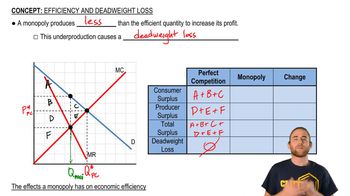
  • What is the end result of the creation of a monopoly in terms of market efficiency and surplus?

    The creation of a monopoly results in reduced output and higher prices compared to perfect competition, leading to a decrease in consumer surplus, a change in producer surplus, and the emergence of deadweight loss due to lost economic surplus from unmade trades.
  • A profit-maximizing monopolist will continue expanding output as long as which condition is met?

    A profit-maximizing monopolist will continue expanding output as long as marginal revenue is greater than marginal cost.
  • How can the economic inefficiency of a monopolist be measured?

    The economic inefficiency of a monopolist can be measured by the deadweight loss, which represents the loss of total surplus (areas C and E) compared to perfect competition.
  • How do you calculate the deadweight loss associated with the monopoly situation shown on a surplus graph?

    To calculate the deadweight loss in a monopoly, identify the areas on the graph (typically labeled C and E) that represent the lost surplus from trades that do not occur due to reduced output; the sum of these areas is the deadweight loss.
  • Why does deadweight loss occur in a monopoly?

    Deadweight loss occurs in a monopoly because the monopolist restricts output below the efficient quantity, causing some mutually beneficial trades between buyers and sellers to not take place.
  • In a monopoly, how is the price determined for the quantity produced?

    The price in a monopoly is set by finding the quantity where marginal revenue equals marginal cost, then going up to the demand curve to determine the price consumers will pay for that quantity.
  • Which areas on a surplus graph represent the consumer surplus under perfect competition?

    Under perfect competition, consumer surplus is represented by areas A, B, and C, which are above the price and below the demand curve.
  • Why do monopolies fail to achieve productive efficiency?

    Monopolies do not produce at the minimum of the average total cost curve, so they fail to achieve productive efficiency and instead produce at a higher average cost.
  • What happens to producer surplus when a market shifts from perfect competition to monopoly?

    Producer surplus changes from areas D, E, and F in perfect competition to B, D, and F in monopoly, with producers gaining area B from consumers but losing area E.
  • How does a monopoly affect allocative efficiency in the market?

    A monopoly does not achieve allocative efficiency because it produces less than the efficient quantity, causing the marginal benefit to consumers to exceed the marginal cost to producers.