Back

Efficiency in Monopolistic Competition quiz

Control buttons has been changed to "navigation" mode.
1/15
  • What is productive efficiency in microeconomics?

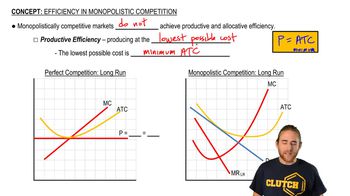
    Productive efficiency is producing at the lowest possible cost, which occurs at the minimum of the average total cost curve.
  • Do monopolistically competitive firms achieve productive efficiency?

    No, monopolistically competitive firms do not achieve productive efficiency because they do not produce at the minimum of the average total cost curve.
  • Why do monopolistically competitive firms have excess capacity?

    They have excess capacity because their demand curve only allows them to be tangent to the downward sloping part of the average total cost curve, not at its minimum.
  • Where do perfectly competitive firms produce in the long run?

    Perfectly competitive firms produce at the minimum of the average total cost curve in the long run, achieving productive efficiency.
  • What is the profit-maximizing condition for monopolistically competitive firms?

    Monopolistically competitive firms maximize profit where marginal revenue equals marginal cost.
  • Do monopolistically competitive firms produce at the minimum average total cost in the long run?

    No, they produce at a quantity before the minimum average total cost, resulting in higher costs than necessary.
  • What is allocative efficiency?

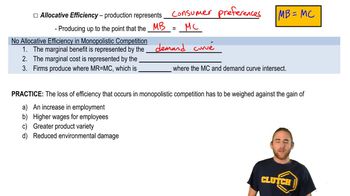
    Allocative efficiency occurs when production represents consumer preferences, specifically where marginal benefit equals marginal cost.
  • How is marginal benefit represented in microeconomics?

    Marginal benefit is represented by the demand curve, reflecting the benefits consumers receive from a product.
  • How is marginal cost represented in microeconomics?

    Marginal cost is represented by the marginal cost curve, showing the cost to producers of making one more unit.
  • Where is the allocatively efficient quantity found on a graph?

    The allocatively efficient quantity is where the demand curve (marginal benefit) intersects the marginal cost curve.
  • Do monopolistically competitive firms produce at the allocatively efficient quantity?

    No, they produce at a lower quantity than the allocatively efficient quantity to maximize profit.
  • What is the relationship between marginal benefit and marginal cost at the profit-maximizing quantity in monopolistic competition?

    At the profit-maximizing quantity, the marginal benefit to consumers is greater than the marginal cost to producers.
  • What does it mean if marginal benefit is greater than marginal cost in monopolistic competition?

    It means that more units should be produced for social efficiency, as consumers value additional units more than they cost to produce.
  • Why is monopolistic competition not socially efficient?

    Because firms produce less than the allocatively efficient quantity, leading to unmet consumer demand and higher costs.
  • What is the main difference in efficiency between perfect competition and monopolistic competition?

    Perfect competition achieves both productive and allocative efficiency, while monopolistic competition achieves neither.