Economists typically express the elasticity coefficient as an absolute value in order to:
Ensure that price elasticity of demand and supply is always represented as a positive number, making it easier to compare elasticities and focus on the magnitude of responsiveness rather than the direction of change.
What formula is used to calculate price elasticity of demand?
Price elasticity of demand is calculated as the percentage change in quantity demanded divided by the percentage change in price.
How do you determine whether demand is elastic or inelastic using the elasticity coefficient?
If the elasticity coefficient is greater than 1, demand is elastic; if it is less than 1, demand is inelastic.
Why is it important to check the sign of the elasticity coefficient for income and cross-price elasticity?
The sign indicates the nature of the good: positive for normal goods or substitutes, and negative for inferior goods or complements.
What variables are used in the formula for income elasticity of demand?
Income elasticity of demand uses percentage change in quantity demanded and percentage change in income.
What does a negative cross-price elasticity indicate about two goods?
A negative cross-price elasticity means the goods are complements.
At what point on a straight-line demand curve is total revenue maximized?
Total revenue is maximized at the unit elastic point, which is the midpoint of the demand curve.
What happens to total revenue if price increases and demand is inelastic?
If demand is inelastic, increasing price will increase total revenue.
What step should you take after calculating elasticity using the midpoint method?
After calculating, you should check the signs of the changes in quantity and price or income to interpret the result correctly.
How are the formulas for price elasticity of supply and demand similar?
Both formulas use percentage change in quantity (supplied or demanded) divided by percentage change in price.
What is the best definition of elasticity in economics?
Elasticity in economics measures how much one variable, such as quantity demanded or supplied, responds to a change in another variable, such as price, income, or the price of another good.
What does elasticity measure in economics?
Elasticity measures the responsiveness of quantity demanded or supplied to changes in price, income, or the price of related goods.
How is price elasticity of demand calculated, and what does its value indicate?
Price elasticity of demand is calculated as the percentage change in quantity demanded divided by the percentage change in price. A value greater than one indicates elastic demand, less than one indicates inelastic demand, and exactly one indicates unit elastic demand.
 Back
Back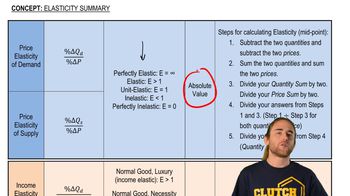
 04:06
04:06