Reflects the current price of one currency in terms of another, showing how much foreign currency can be traded for a unit of domestic currency.
Real Exchange Rate
Measures purchasing power by comparing the cost of goods across countries, adjusting for price levels to show how many foreign goods one domestic good can buy.
Currency Appreciation
Occurs when a currency can buy more of a foreign currency, indicating increased strength relative to other currencies.
Currency Depreciation
Occurs when a currency can buy less of a foreign currency, indicating decreased strength relative to other currencies.
Purchasing Power
Represents the quantity of goods or services that can be bought with a unit of currency in different countries.
Price Level
Indicates the average cost of goods and services in a country, used to adjust exchange rates for real comparisons.
International Trade
Involves the exchange of goods and services across borders, influenced by both nominal and real exchange rates.
Economic Equilibrium
Describes a state where supply and demand are balanced, often affected by changes in exchange rates.
Foreign Currency
Refers to money used in another country, exchanged for domestic currency at prevailing rates.
Domestic Currency
Refers to the official money used within a country, compared to foreign currency in exchange rate calculations.
Goods
Physical items traded or purchased, used to compare purchasing power between countries in real exchange rate calculations.
Exchange Rate Formula
Combines nominal exchange rate and price levels to determine the real exchange rate, showing relative value of goods.
Bank
Institution where currency exchange occurs, providing current nominal exchange rates for transactions.
Sandwich Example
Illustrates real exchange rate by comparing the cost of a specific good in two countries, highlighting purchasing power.
Unit Cancellation
Process in exchange rate calculations where currency units are eliminated to compare goods directly.
 Back
Back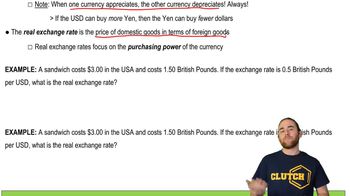
 09:46
09:46