Skip to main content
Microeconomics
My Course
Learn
Exam Prep
AI Tutor
Study Guides
Flashcards
Explore
Try the app
My Course
Learn
Exam Prep
AI Tutor
Study Guides
Flashcards
Explore
Try the app
Back
Factors of Production quiz #5
You can tap to flip the card.
Government investment in human capital is likely to shift:
You can tap to flip the card.
👆
Government investment in human capital is likely to shift:
It is likely to shift the productivity and output of the economy upward.
Track progress
Control buttons has been changed to "navigation" mode.
1/29
Related flashcards
Related practice
Recommended videos
Factors of Production quiz #1
Factors of Production
35 Terms
Factors of Production quiz #2
Factors of Production
36 Terms
Factors of Production quiz #3
Factors of Production
39 Terms
Factors of Production
0. Basic Principles of Economics
10 problems
Topic
Circular Flow Diagram
0. Basic Principles of Economics
10 problems
Topic
0. Basic Principles of Economics
13 topics
14 problems
Chapter
Guided course
02:08
Human Capital and Entrepreneurship
4483
views
152
rank
Guided course
03:09
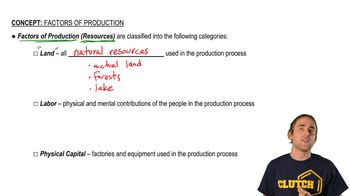
Land, Labor, and Physical Capital
5623
views
107
rank
Terms in this set (29)
Hide definitions
Government investment in human capital is likely to shift:
It is likely to shift the productivity and output of the economy upward.
The exchange of factors of production for income occurs in the ______ market.
It occurs in the resource (factor) market.
A factor that is likely to affect the market price of a stock is:
Economic conditions and resource availability can affect stock prices.
The power given to an individual producer is determined by:
It is determined by control over resources and market share.
A corn farm, a coal mine, and a fishing company are all part of the _________ industry.
They are part of the primary industry.
Economic factors in decision making fall under the category of:
They fall under the category of resources or factors of production.
What is not a factor of production?
Time is not a factor of production.
What is the result of an increase in input prices on production?
It will increase production costs and reduce output.
What addresses the economic question of how to produce?
The choice and combination of factors of production address how to produce.
What most likely promotes long-run economic growth?
Investment in human capital and technology promotes long-run growth.
What are examples of resources for a firm?
Land, labor, capital, and entrepreneurship are resources for a firm.
What is an example of capital?
A factory is an example of capital.
What must a manager do in the production process?
The manager must organize and allocate resources efficiently.
Why do business firms need financial capital?
Firms need financial capital to invest in physical capital and expand production.
An improvement in production technology will:
It will increase productivity and output.
Businesses that produce and sell tangible products such as steel and machines are part of the:
They are part of the manufacturing sector.
Industrial machinery is an example of:
Industrial machinery is an example of physical capital.
Another term for factors of production is:
Another term is economic resources.
Simply put, ______ are the economic resources of a company. (enter only one word.)
Resources
______ are economic resources owned by a firm.
Assets are economic resources owned by a firm.
List one factor that could cause demand to decrease for certain goods during a pandemic.
Reduced consumer income could decrease demand.
Job specialization is known to:
Job specialization increases efficiency and productivity.
The traditional view of the production process is that capital is subject to:
Capital is subject to diminishing returns.
Variable inputs are defined as any resource that:
Variable inputs can be changed in the short run to increase or decrease output.
Utilization is defined as the ratio of:
Utilization is the ratio of actual output to potential output.
Educated people may generate ideas that increase production. These ideas:
These ideas increase human capital and productivity.
An employee's initial wage rate is determined by:
It is determined by their skills, education, and market demand.
______ is the creation of finished goods and services using the factors of production.
Production is the creation of finished goods and services.
An increase in input productivity will:
It will increase output and reduce costs.
 BackBack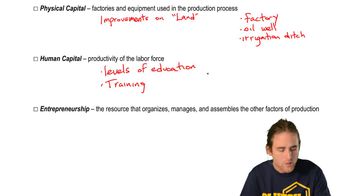
 02:08
02:08