If the four largest firms in a market produce 88 percent of total industry output, what type of market structure does this indicate?
This indicates an oligopoly, as a few firms dominate the market and produce the majority of the industry's output.
What is the minimum number of firms required for a market to be classified as an oligopoly?
At least two firms are required for a market to be considered an oligopoly; otherwise, it would be a monopoly.
Name two industries commonly cited as examples of oligopolies.
The soft drink industry (Coke and Pepsi) and the aluminum industry are common examples of oligopolies.
How do barriers to entry in oligopoly markets compare to those in monopoly markets?
Barriers to entry in oligopoly markets are high, similar to those in monopoly markets, making it difficult for new firms to enter.
Why can't oligopolies use the simple rule of marginal revenue equals marginal cost to determine profit-maximizing output?
Oligopolies must use strategic pricing based on competitors' actions, so profit maximization is not determined solely by marginal revenue equaling marginal cost.
How does long-run profitability in oligopolies differ from that in more competitive markets?
Oligopolies can maintain long-run profitability due to limited competition and significant market power.
What type of demand curve do firms in an oligopoly face?
Firms in an oligopoly face a downward sloping demand curve.
In an oligopoly, how does the price typically compare to marginal cost and marginal revenue?
In an oligopoly, the price is greater than both marginal cost and marginal revenue.
What concept is used to analyze the strategic interactions between firms in an oligopoly?
Game theory is used to analyze the strategic interactions and interdependence between firms in an oligopoly.
How does market power affect the ability of oligopoly firms to influence prices and output?
Oligopoly firms have significant market power, allowing them to influence both prices and output in the market.
 Back
Back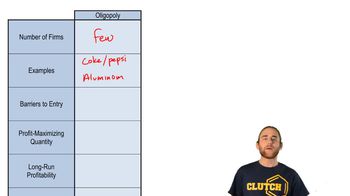
 03:39
03:39