Skip to main content
Microeconomics
My Course
Learn
Exam Prep
AI Tutor
Study Guides
Flashcards
Explore
Try the app
My Course
Learn
Exam Prep
AI Tutor
Study Guides
Flashcards
Explore
Try the app
Back
Four Market Model Summary: Perfect Competition definitions
You can tap to flip the card.
Perfect Competition
You can tap to flip the card.
👆
Perfect Competition
A market with countless firms where no single producer can affect the prevailing price, ensuring uniformity in product pricing.
Track progress
Control buttons has been changed to "navigation" mode.
1/15
Related flashcards
Related practice
Recommended videos
Four Market Model Summary: Perfect Competition quiz
Four Market Model Summary: Perfect Competition
15 Terms
Four Market Model Summary: Perfect Competition
11. Perfect Competition
10 problems
Topic
Perfect Competition and Efficiency
11. Perfect Competition
10 problems
Topic
11. Perfect Competition
11 topics
15 problems
Chapter
Guided course
05:02
Four Market Model Summary: Perfect Competition
1939
views
19
rank
Terms in this set (15)
Hide definitions
Perfect Competition
A market with countless firms where no single producer can affect the prevailing price, ensuring uniformity in product pricing.
Market Price
The prevailing value at which goods are exchanged, determined by overall supply and demand, not by individual sellers.
Barriers to Entry
Obstacles preventing new firms from joining a market, absent in this structure, allowing unrestricted participation.
Profit Maximization
Achieved when additional revenue from selling one more unit equals the extra cost incurred, guiding optimal output.
Marginal Revenue
The extra income received from selling one additional unit, identical to price in this market structure.
Marginal Cost
The added expense from producing one more unit, crucial for determining optimal production levels.
Average Revenue
Total income divided by quantity sold, matching price in this market, forming a horizontal line on graphs.
Economic Profit
Earnings after accounting for all explicit and implicit costs, including opportunity costs, which vanish in the long run.
Average Total Cost
Overall production expenses per unit, with market price stabilizing at its lowest point in the long run.
Productive Efficiency
Occurs when goods are produced at the lowest possible cost, achieved when price equals minimum average total cost.
Allocative Efficiency
Realized when resources are distributed to maximize societal benefit, indicated by price equaling marginal cost.
Long Run
A period where firms can freely enter or exit, leading to zero economic profit and price equaling minimum average total cost.
Short Run Shutdown
A temporary halt in production when revenue fails to cover variable costs, distinct from permanent market exit.
Foreign Exchange Market
A setting where currencies are traded, exemplifying this market structure due to standardized products and price-taking behavior.
Wheat Market
An agricultural sector illustrating this model, with numerous producers and indistinguishable products.
 BackBack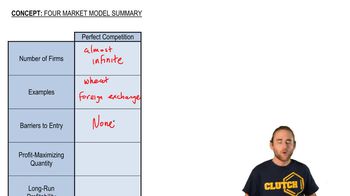
 05:02
05:02