A graph of total fixed cost is a horizontal line, indicating that total fixed cost does not change as output increases.
Which phrase best describes the graph of a proportional relationship?
A proportional relationship is represented by a straight line passing through the origin, showing that one variable is a constant multiple of the other.
What is always true of a dependent system of two equations?
A dependent system of two equations has infinitely many solutions because the equations represent the same line on a graph.
The trend shown on the graph above is best explained by which potential issue in graph interpretation?
The trend could be best explained by omitted variable bias or reverse causality, both of which are common pitfalls in interpreting graphs.
How could this graph help an economist make predictions?
A graph can help an economist predict future trends or outcomes by illustrating relationships between variables, such as how changes in one variable may affect another.
How does the arc method differ from the point method when calculating slope on a graph?
The arc method calculates the average slope between two selected points on a curve, while the point method finds the slope at a single point.
What steps do you follow to calculate the area of a rectangle on a graph?
You identify two points to define the base and height, then multiply the base by the height to find the area.
Why might the slope calculated using the arc method change depending on the points chosen?
The slope changes because the curve's steepness varies at different regions, so selecting different points yields different average slopes.
What is an example of reverse causality in graph interpretation?
Reverse causality occurs when the effect is mistaken for the cause, such as assuming more police officers cause more crime instead of more crime leading to more police officers.
 Back
Back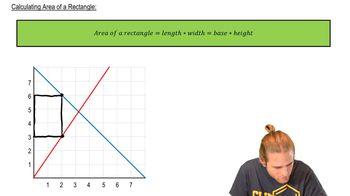
 02:36
02:36