Skip to main content
Microeconomics
My Course
Learn
Exam Prep
AI Tutor
Study Guides
Flashcards
Explore
Try the app
My Course
Learn
Exam Prep
AI Tutor
Study Guides
Flashcards
Explore
Try the app
Back
Import Quotas and VERs quiz #1
You can tap to flip the card.
What is an example of an import quota?
You can tap to flip the card.
👆
What is an example of an import quota?
An example of an import quota is a government policy that limits the import of oversized lollipops to 25,000 units per year.
Track progress
Control buttons has been changed to "navigation" mode.
1/10
Related flashcards
Related practice
Recommended videos
Import Quotas and VERs definitions
Import Quotas and VERs
15 Terms
Import Quotas and VERs
9. International Trade
10 problems
Topic
Arguments Against International Trade
9. International Trade
10 problems
Topic
9. International Trade
5 topics
15 problems
Chapter
Guided course
14:08
Import Quotas and VERs
3177
views
22
rank
Guided course
09:44
Import Quota
2581
views
36
rank
Terms in this set (10)
Hide definitions
What is an example of an import quota?
An example of an import quota is a government policy that limits the import of oversized lollipops to 25,000 units per year.
What is the effect of import restrictions, such as quotas, on domestic prices?
Import restrictions like quotas raise domestic prices by limiting the supply of imported goods, resulting in higher prices for consumers.
Import quotas are numerical limitations on the quantity of products that can be imported. What term describes these numerical limitations?
Import quotas are numerical limitations on the quantity of products that can be imported.
How does an import quota affect the quantity of imports compared to free trade?
An import quota reduces the quantity of imports allowed, lowering it from the free trade level to the quota limit set by the government.
What happens to consumer surplus when an import quota is imposed?
Consumer surplus decreases because the higher domestic price and reduced availability of imports make consumers worse off.
Who benefits from the surplus created by an import quota, and how is this different from a tariff?
Foreign producers benefit from the surplus created by an import quota, whereas with a tariff, the government collects the revenue instead.
What is deadweight loss in the context of import quotas, and which areas of the graph does it represent?
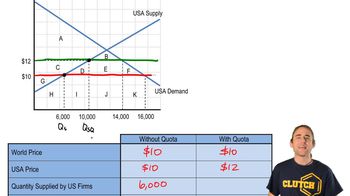
Deadweight loss refers to the lost gains from trade due to restricted imports, represented by sections D and F on the graph.
How does a voluntary export restraint (VER) differ from an import quota in terms of who sets the restriction?
A VER is set by the exporting country as a self-imposed limit, while an import quota is imposed by the importing country's government.
Why might a government choose an import quota over a tariff, according to the lesson?
Governments may choose quotas for political reasons, as quotas allow foreign producers to benefit, making them less opposed than with tariffs.
At what price are imports sold in the domestic market after a quota is imposed, and why?
Imports are sold at the new higher domestic price, not the world price, because the quota restricts supply and raises the market price.
 BackBack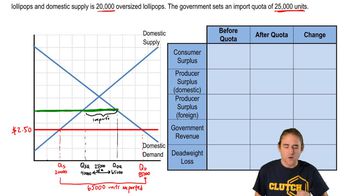
 14:08
14:08