Skip to main content
Microeconomics
My Course
Learn
Exam Prep
AI Tutor
Study Guides
Flashcards
Explore
Try the app
My Course
Learn
Exam Prep
AI Tutor
Study Guides
Flashcards
Explore
Try the app
Back
Long Run Aggregate Supply quiz
You can tap to flip the card.
What does the vertical shape of the long-run aggregate supply (LRAS) curve represent?
You can tap to flip the card.
👆
What does the vertical shape of the long-run aggregate supply (LRAS) curve represent?
It represents that real GDP in the long run depends on the availability of factors of production, not the price level.
Track progress
Control buttons has been changed to "navigation" mode.
1/15
Related flashcards
Recommended videos
Long Run Aggregate Supply definitions
Long Run Aggregate Supply
15 Terms
Guided course
04:36
Long Run Aggregate Supply
5
views
Guided course
04:35
Shifting Long Run Aggregate Supply
6
views
Terms in this set (15)
Hide definitions
What does the vertical shape of the long-run aggregate supply (LRAS) curve represent?
It represents that real GDP in the long run depends on the availability of factors of production, not the price level.
Which factors determine the position of the LRAS curve?
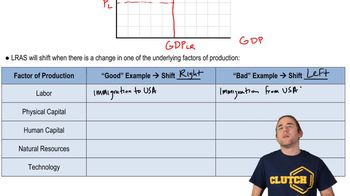
The position is determined by the amount of labor, physical capital, human capital, natural resources, and technology available.
How does an increase in the labor force affect the LRAS curve?
An increase in the labor force shifts the LRAS curve to the right, indicating higher potential output.
What happens to LRAS if there is a decrease in available natural resources?
A decrease in natural resources shifts the LRAS curve to the left, reducing the economy's potential output.
Why does the price level not affect long-run aggregate supply?
Because in the long run, output is limited by resources, not by the price level; the economy produces at its full potential regardless of prices.
What is meant by 'full employment' in the context of LRAS?
Full employment means all available resources are being used efficiently, and the economy is producing at its maximum sustainable output.
How does technological progress affect the LRAS curve?
Technological progress shifts the LRAS curve to the right by increasing productivity and potential output.
What effect does increased physical capital have on LRAS?
Increased physical capital, such as more factories and equipment, shifts the LRAS curve to the right.
How does improved human capital influence the LRAS curve?
Improved human capital, like better education or training, shifts the LRAS curve to the right by making workers more productive.
What would cause the LRAS curve to shift to the left?
A reduction in any factor of production, such as labor, capital, resources, or technology, would shift the LRAS curve to the left.
If a country experiences significant immigration, what happens to its LRAS?
Significant immigration increases the labor force, shifting the LRAS curve to the right.
Why is real GDP used instead of nominal GDP when analyzing LRAS?
Real GDP is used because it measures the actual quantity of goods and services produced, unaffected by changes in price level.
What does a rightward shift of the LRAS curve indicate about an economy?
It indicates that the economy's potential output has increased, allowing for more goods and services to be produced in the long run.
How would the discovery of a large oil deposit affect the LRAS curve?
The discovery would increase available natural resources, shifting the LRAS curve to the right.
What is the relationship between scarcity and the LRAS curve?
Scarcity of resources limits the position of the LRAS curve, as it determines the maximum output the economy can sustain.
 BackBack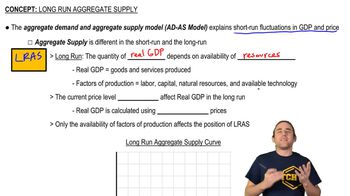
 04:36
04:36