Long Run Entry and Exit Decision quiz #1 Flashcards

Long Run Entry and Exit Decision quiz #1
Control buttons has been changed to "navigation" mode.
1/10
  • Which scenario is most likely to cause firms to exit a perfectly competitive industry in the long run?
    Firms are most likely to exit a perfectly competitive industry in the long run when the market price falls below their average total cost (ATC), meaning they cannot cover all their costs and earn a profit. If total revenue is less than total cost, firms will exit the market.
  • In the long run, why are all costs considered variable for a firm's exit decision?
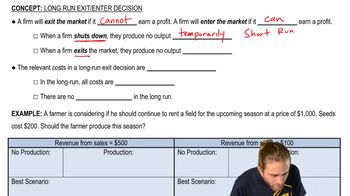
    In the long run, firms can adjust all inputs, so fixed costs become variable and can be eliminated if the firm exits the market.
  • How does the long run exit decision differ from a short run shutdown?
    A long run exit is permanent, with the firm leaving the market entirely, while a short run shutdown is temporary and the firm may resume production later.
  • What role does opportunity cost play in determining economic profit for long run exit decisions?
    Opportunity costs are included in economic profit calculations, so a firm may have zero economic profit even if it has positive accounting profit.
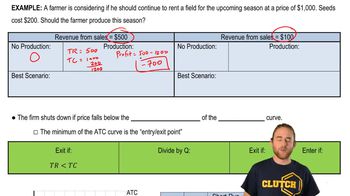
  • If a farmer has not yet rented a field, what is the best decision if expected revenue is less than total cost?
    The farmer should choose not to produce and avoid renting the field, resulting in zero profit and zero loss.
  • At what price level will a firm earn zero economic profit in the long run?
    A firm earns zero economic profit when the market price equals its average total cost (ATC).
  • Why is average variable cost (AVC) not relevant for long run exit decisions?
    In the long run, all costs are variable, so the decision is based on average total cost (ATC) rather than AVC.
  • What happens to a firm's production decision if the market price is below average variable cost in both the short and long run?
    The firm will not produce in either the short run or the long run, as it cannot cover its variable costs.
  • How does the ability to adjust fixed costs in the long run affect a firm's exit decision?
    Since fixed costs can be eliminated in the long run, firms can exit the market without incurring those costs, making all costs avoidable.
  • What is the significance of the minimum point of the average total cost curve in long run entry and exit decisions?
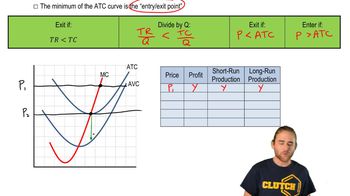
    The minimum point of the ATC curve represents the threshold price; firms will exit if the price falls below this point and enter if it rises above it.