What is an example of a long-run adjustment for a firm in a competitive market?
A firm entering or exiting the market in response to sustained economic profits or losses.
If market conditions do not change, what will a competitive firm do in the long run?
The firm will continue to produce at the quantity where marginal cost equals marginal revenue, earning zero economic profit.
In the long run, if a firm decides to keep its output at the initial level, what will it likely do?
The firm will produce at the minimum average total cost, maintaining zero economic profit.
What happens to the market price in the short run when demand increases in a perfectly competitive market?
The market price rises above the original equilibrium price, allowing firms to earn economic profits in the short run.
How does the entry of new firms affect the supply curve after an increase in demand?
The supply curve shifts to the right as new firms enter, increasing the total quantity supplied in the market.
In long-run equilibrium, what is the relationship between price and average total cost for competitive firms?
Price equals the minimum average total cost, resulting in zero economic profit for firms.
Why do firms enter the market when short-run profits exist in a competitive industry?
Firms are attracted by the opportunity to earn profits, so they enter the market, which increases supply and eventually eliminates those profits.
After all market adjustments following a demand increase, what happens to the equilibrium price in the long run?
The equilibrium price returns to the original level, equal to the minimum average total cost, despite the higher quantity supplied.
What ensures that economic profits are eliminated in the long run in a perfectly competitive market?
The process of firms entering or exiting the market in response to profits or losses ensures that economic profits are eliminated and the market returns to long-run equilibrium.
 Back
Back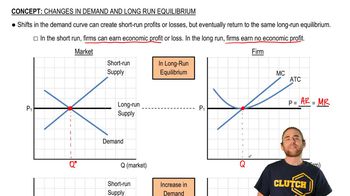
 07:04
07:04