Which Gini coefficient indicates the lowest degree of income inequality among 0.2, 0.4, 0.6, and 0.8?
A Gini coefficient of 0.2 indicates the lowest degree of income inequality, as the Gini coefficient ranges from 0 (perfect equality) to 1 (perfect inequality).
Based on the information in the Lorenz curve above, what does it mean if the curve is close to the line of perfect equality?
If the Lorenz curve is close to the line of perfect equality, it means that income is distributed more equally among households.
The Gini coefficient is a numerical measure of the overall distribution of income in the economy. What does a Gini coefficient of 0 represent?
A Gini coefficient of 0 represents perfect income equality, where everyone earns the same income.
What do the axes on a Lorenz curve graph represent?
The horizontal axis shows the cumulative percentage of households, while the vertical axis shows the cumulative percentage of income.
How is the population divided when constructing a Lorenz curve?
The population is divided into quintiles, with each quintile representing 20% of households.
What does the line of perfect equality look like on a Lorenz curve graph?
It is a straight diagonal line where each percentage of households earns the same percentage of income, indicating no income inequality.
How do you calculate cumulative income percentages for the Lorenz curve?
You add the income shares of each quintile sequentially to get the cumulative percentage for each group.
What does the Lorenz curve illustrate about income distribution?
It visually shows the degree of income inequality by comparing actual income distribution to perfect equality.
In the case of complete income inequality, how would the Lorenz curve appear?
The curve would remain at zero until the last household, then jump to 100%, showing one household earns all the income.
What is the formula for calculating the Gini coefficient using areas on the Lorenz curve graph?
The Gini coefficient is calculated as A divided by (A + B), where A is the area between the Lorenz curve and the line of equality, and B is the area below the Lorenz curve.
 Back
Back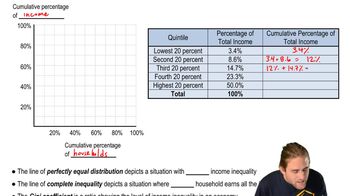
 11:30
11:30