Pearson+ LogoPearson+ Logo

Median Voter Theorem quiz #1 Flashcards

Median Voter Theorem quiz #1
Control buttons has been changed to "navigation" mode.
1/10
  • What are the main implications of the median-voter model in majority voting systems?

    The median-voter model implies that the outcome of majority voting tends to reflect the preference of the median voter, even if many voters are dissatisfied. Policies will align with the median preference, and individuals may relocate to areas where the median voter shares their views.
  • What does public choice theory, as demonstrated by the median voter theorem, reveal about majority voting outcomes?

    Public choice theory, through the median voter theorem, shows that majority voting results in policies that match the median voter's preference, not necessarily the ideal choice for all voters. This means the median voter has decisive influence over election outcomes.
  • How is the median value determined in a set of voter preferences?

    The median is found by removing the highest and lowest values repeatedly until one value remains, which separates the higher half from the lower half of the data set.
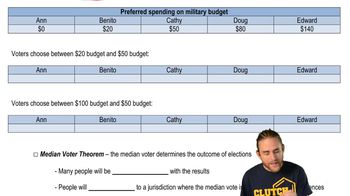
  • In the military spending example, what was the median preference among the five voters?

    The median preference was $50, which was the middle value after arranging all five preferences in order.
  • Why do voters choose the option closest to their preference in majority voting?

    Voters select the closest available option because they often cannot get their ideal choice, so they vote for what is nearest to their own preference.
  • What happens to the outcome when the vote is between the median and a higher budget option?

    The median option still wins because voters with preferences below the median align with it, outnumbering those who prefer the higher option.
  • How does the median voter theorem explain voter dissatisfaction?

    It shows that many voters may be unhappy with the outcome since only the median voter's preference is reflected, leaving others with less preferred results.
  • What strategy might dissatisfied voters use according to the median voter theorem?

    Dissatisfied voters may relocate to areas where the median voter’s preferences are closer to their own, seeking policies that better match their views.
  • In the example, which voter consistently gets their preferred outcome in both voting scenarios?

    Kathy, the median voter, consistently gets her preferred outcome of $50 in both voting scenarios.
  • How does the median voter theorem affect policy outcomes in different jurisdictions?

    Policy outcomes in each jurisdiction tend to reflect the preferences of the local median voter, influencing where people choose to live based on policy alignment.