Skip to main content
Microeconomics
My Course
Learn
Exam Prep
AI Tutor
Study Guides
Flashcards
Explore
Try the app
My Course
Learn
Exam Prep
AI Tutor
Study Guides
Flashcards
Explore
Try the app
Back
Microeconomics vs. Macroeconomics definitions
You can tap to flip the card.
Economics
You can tap to flip the card.
👆
Economics
A social science examining how individuals, institutions, and society allocate limited resources to satisfy unlimited wants.
Track progress
Control buttons has been changed to "navigation" mode.
1/15
Related flashcards
Related practice
Recommended videos
Microeconomics vs. Macroeconomics quiz #1
Microeconomics vs. Macroeconomics
10 Terms
Microeconomics vs. Macroeconomics
0. Basic Principles of Economics
10 problems
Topic
Factors of Production
0. Basic Principles of Economics
10 problems
Topic
0. Basic Principles of Economics
13 topics
14 problems
Chapter
Guided course
02:16
Definition of Economics:Micro vs. Macro
4493
views
129
rank
Terms in this set (15)
Hide definitions
Economics
A social science examining how individuals, institutions, and society allocate limited resources to satisfy unlimited wants.
Scarcity
A condition where available resources are insufficient to meet all human desires, driving choices and trade-offs.
Microeconomics
A branch focusing on individual and business decisions, including pricing, supply, demand, and operational choices.
Macroeconomics
A field analyzing national and global economic phenomena such as recessions, inflation, and unemployment.
Supply
The quantity of a good or service that producers are willing to offer at various prices in a market.
Demand
The amount of a product consumers are willing and able to purchase at different price levels.
Price
The monetary value assigned to a good or service, influencing both consumer behavior and producer decisions.
Tax
A compulsory financial charge imposed by governments, affecting market outcomes like supply and demand.
Profit
The financial gain achieved when total revenue exceeds total costs in business operations.
Monopoly
A market structure where a single seller dominates, often leading to unique pricing and output decisions.
Perfect Competition
A market characterized by many sellers offering identical products, resulting in efficient pricing and resource allocation.
Labor
The human effort used in production, with decisions involving hiring and wage determination.
Recession
A period of economic decline marked by reduced output, employment, and spending across a nation or region.
Inflation
A sustained increase in general price levels, impacting purchasing power and interest rates.
Unemployment
The condition where individuals able and willing to work are unable to find jobs, often tracked as an economic indicator.
 BackBack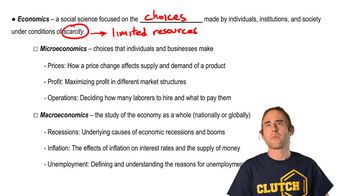
 02:16
02:16