Skip to main content
Microeconomics
My Course
Learn
Exam Prep
AI Tutor
Study Guides
Flashcards
Explore
Try the app
My Course
Learn
Exam Prep
AI Tutor
Study Guides
Flashcards
Explore
Try the app
Back
Monetarist Model quiz
You can tap to flip the card.
Who developed the Monetarist Model and in what decade did he win the Nobel Prize?
You can tap to flip the card.
👆
Who developed the Monetarist Model and in what decade did he win the Nobel Prize?
Milton Friedman developed the Monetarist Model and won the Nobel Prize in the 1970s.
Track progress
Control buttons has been changed to "navigation" mode.
1/15
Related flashcards
Recommended videos
Monetarist Model definitions
Monetarist Model
14 Terms
Guided course
04:06
Monetarist Model
4
views
Terms in this set (15)
Hide definitions
Who developed the Monetarist Model and in what decade did he win the Nobel Prize?
Milton Friedman developed the Monetarist Model and won the Nobel Prize in the 1970s.
What is the main focus of the Monetarist Model in macroeconomics?
The Monetarist Model primarily focuses on the money supply as the key to economic stability.
What is the formula for the quantity theory of money?
The formula is M × V = P × Y, where M is money supply, V is velocity of money, P is price level, and Y is real GDP.
How do Monetarists view the stability of the velocity of money?
Monetarists believe that the velocity of money is stable and remains roughly the same each year.
According to Monetarists, what happens if the money supply grows steadily?
A steady growth in the money supply leads to consistent growth in real GDP.
How does the Monetarist Model differ from Keynesian Economics regarding government intervention?
The Monetarist Model argues for less government intervention, believing markets are more stable than Keynesians suggest.
Who controls the money supply in the United States?
The Federal Reserve, which is the central bank of the United States, controls the money supply.
What does the velocity of money represent?
It represents how many times a dollar is spent and re-spent in the economy during a year.
What economic events in the 1970s challenged the effectiveness of the Monetarist Model?
High inflation during the 1970s led to doubts about the effectiveness of the Monetarist Model.
What is the Monetarist view on market stability?
Monetarists believe that competitive markets are generally stable and do not require frequent government intervention.
What does the quantity theory of money connect?
It connects the money supply with the overall price level in the economy.
How did Keynesian Economics view wages and prices compared to Monetarists?
Keynesians believed in sticky wages and prices, while Monetarists did not emphasize this.
What role did the Monetarist Model play in monetary policy during the 1970s and early 1980s?
It heavily influenced monetary policy decisions during that period.
What is the main criticism of the Monetarist Model based on historical outcomes?
The main criticism is that it failed to prevent high inflation when applied in the 1970s.
What does the 'P × Y' part of the quantity theory of money formula represent?
'P × Y' represents the price level multiplied by real GDP, which equals nominal GDP.
 BackBack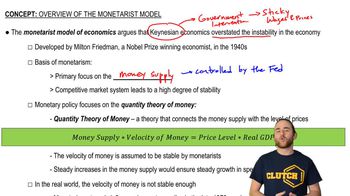
 04:06
04:06