Refer to Figure 15-4. What price will the monopolist charge in order to maximize profit?
The monopolist will charge the price corresponding to the quantity where marginal revenue equals marginal cost, as shown on Figure 15-4. This price is found on the demand curve at that quantity.
What was the core business that made Standard Oil a horizontally integrated monopoly?
Standard Oil's core business was oil refining, and it became a horizontally integrated monopoly by controlling most oil refineries and consolidating competitors in the industry.
What does the perceived demand curve look like for a monopolistic competitor?
The perceived demand curve for a monopolistic competitor is downward sloping, similar to that of a monopoly.
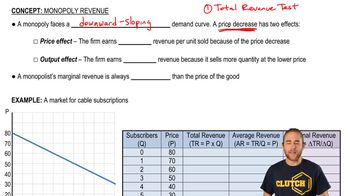
A single-price monopolist’s marginal revenue is:
Always less than the price of the good due to the downward sloping demand curve and the price/output effects.
In order to sell more of its product, a monopolist must:
Lower the price, since the demand curve is downward sloping.
A profit-maximizing monopoly's price is:
Greater than marginal revenue and marginal cost at the profit-maximizing quantity.
To find the quantity chosen by a monopolist, find the point at which marginal revenue equals _____.
Marginal cost.
If a monopolist wishes to sell an additional unit of the good, then:
It must lower the price, which reduces revenue on all units sold.
For a monopoly, the marginal revenue curve is located below the demand curve.
True. The marginal revenue curve lies below the demand curve because marginal revenue is less than price.
A monopolistically competitive firm's marginal revenue curve:
Is below its demand curve, just like a monopoly.
Refer to Figure 15-2. A profit-maximizing monopoly's total revenue is equal to:
Price multiplied by quantity sold at the profit-maximizing output.
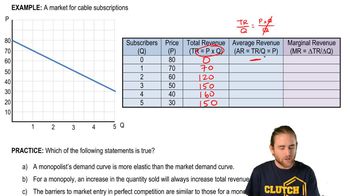
A profit-maximizing monopoly's total revenue is equal to:
The price charged for the good times the quantity sold.