A monopsony is a market with a single buyer of labor, allowing the firm to set wages below the competitive equilibrium and employ fewer workers than in a competitive market.
What is a consequence of a monopsony labor market?
A monopsony results in lower wages and a smaller quantity of labor employed compared to a competitive labor market.
Why is the marginal cost of hiring an additional worker higher than the wage in a monopsonistic labor market?
In a monopsonistic labor market, the marginal cost of hiring an additional worker is higher than the wage because the firm must raise wages for all workers when hiring more.
The monopsonist’s marginal factor (resource) cost curve for labor is:
Steeper than the labor supply curve, because hiring additional workers requires raising wages for all employees, increasing the marginal cost above the wage rate.
How does a monopsony determine the quantity of labor to hire?
A monopsony hires workers up to the point where the marginal cost of labor equals the marginal revenue product of labor. This maximizes the firm's profit in the labor market.
Why is the marginal cost curve for labor steeper in a monopsony than the labor supply curve?
The marginal cost curve is steeper because hiring an additional worker requires raising wages for all existing workers, not just the new hire. This increases the total cost more rapidly than in a competitive market.
What effect does a minimum wage law have on a monopsony labor market?
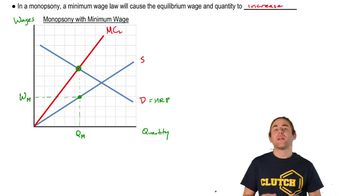
A minimum wage law can raise both the wage and the quantity of labor employed to the competitive equilibrium levels. It sets a wage floor that aligns the marginal cost of labor with the minimum wage up to the equilibrium quantity.
In a monopsony, how is the wage paid to workers determined?
The wage paid is found where the labor supply curve intersects the quantity of labor chosen by the monopsony. This wage is lower than the competitive equilibrium wage.
What is the relationship between the firm's demand for labor and the marginal revenue product in a monopsony?
The firm's demand for labor is based on the marginal revenue product of labor, which reflects the additional value produced by hiring one more worker. This derived demand guides the firm's hiring decisions.
How does the introduction of a minimum wage change the marginal cost of labor in a monopsony?
With a minimum wage, the marginal cost of labor becomes constant and equal to the minimum wage up to the equilibrium quantity. This incentivizes the firm to hire more workers at the higher wage.
 Back
Back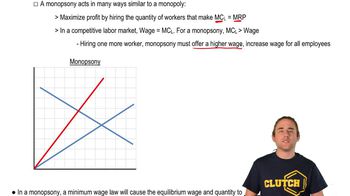
 07:18
07:18