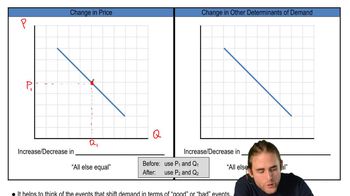
Which of the following factors causes a movement along the demand curve?
A change in the price of the good itself causes a movement along the demand curve, resulting in a change in quantity demanded. Other factors, such as changes in consumer income or preferences, shift the entire demand curve rather than causing movement along it.
What does ceteris paribus mean in the context of analyzing demand?
Ceteris paribus means holding all other factors constant while examining the effect of one variable, such as price or income, on demand.
How is a change in consumer preferences represented on a demand graph?
A change in consumer preferences is shown by shifting the entire demand curve to the right or left, indicating an increase or decrease in demand at every price.
What labels are commonly used for the axes on a demand curve graph?
The vertical axis is labeled 'Price' and the horizontal axis is labeled 'Quantity,' often abbreviated as P and Q.
If the price of a good increases and all else remains constant, what happens to quantity demanded?
Quantity demanded decreases, resulting in a movement up along the existing demand curve.
What is the difference between a change in quantity demanded and a change in demand?
A change in quantity demanded is caused by a change in the good's price, while a change in demand is caused by other factors and shifts the entire demand curve.
How are the original and new demand curves typically labeled when illustrating a shift?
The original demand curve is labeled D1, and the new curve after a shift is labeled D2.
What happens to the demand curve when consumer income increases?
An increase in consumer income shifts the demand curve to the right, indicating higher demand at every price.
When analyzing demand, what does holding 'all else equal' allow economists to do?
It allows economists to isolate the effect of a single variable, such as price or income, on demand without interference from other factors.
Why is it important to distinguish between a movement along the demand curve and a shift of the demand curve?
Because a movement along the curve is due to price changes, while a shift is caused by changes in other determinants, affecting demand at all prices.